

/icon%209.svg)
/icon%2010.svg)
/icon%2011.svg)
/icon%2012.svg)
/icon%2013.svg)
/icon%2014.svg)



For most of 2026, ChatGPT advertising was a moving target for law firms. OpenAI opened the door to paid placements, then the fine print revealed legal services were still off the table. Agencies built campaigns that never launched. Guides were outdated within weeks of publishing.
That changed on August 31, 2026.
OpenAI updated its advertising policy (version 1.5) to permit legal services ads in the United States. For the first time, a licensed attorney can run a ChatGPT ad that does more than point to a free guide. It can say, “We can help with your case.”
Here’s exactly what the policy says, what “licensed to advertise” actually requires, and how to think about it before you spend a dollar.
What OpenAI’s Policy Actually Says Now
As of the August 31, 2026 update, here is the current rule, straight from OpenAI’s Ad Policies page:
- Legal services ads are allowed in the US, but only when the advertiser is licensed to practice law in the jurisdiction where the ad is shown.
- Named practice areas include immigration, personal injury, legal claims, and document preparation, though the permission is not limited to only these examples.
- Legal education content has always been allowed separately. Think legal-themed podcasts or LSAT prep courses, since no legal service is actually being offered.
- Legal services ads outside the US remain prohibited.
Why the Timing Matters
This policy has shifted more than once in 2026, and each version changed what was actually allowed:
- March 2026: OpenAI publishes its first Ad Policies.
- April 2026: Placement rules loosen. Legal, medical, and financial conversations stop being automatically ad-free, but permission to advertise legal services itself does not change yet. This is the update a lot of early coverage misread as “legal ads are open.”
- July 2026: OpenAI formalizes advertiser verification requirements for regulated categories.
- August 31, 2026: Legal services are formally added to the list of permitted, licensed-only categories.
- September 10, 2026: OpenAI clarifies it can still decline any ad at its discretion, even in an approved category.
If you find an article about ChatGPT ads and law firms that is more than a few weeks old, assume part of it is out of date. This is one of the fastest-moving ad policies we have tracked. Treat your own Ads Manager account as the source of truth, not a blog post, including, eventually, this one.
What “Licensed to Advertise” Actually Requires
OpenAI is not opening the gates completely; it is opening them for verified attorneys. In practice, that means:
- Your bar license number and jurisdiction(s) on file with your advertiser account.
- Identity verification: your firm’s details need to match your licensing records. OpenAI’s advertiser policies require a truthful business identity and proof of your professional credentials for regulated categories.
- Geographic targeting that matches your license. You are responsible for making sure your ad does not reach someone in a state where you are not licensed to practice.
- Manual, case-by-case review. Legal remains a restricted category, so expect enhanced verification rather than instant self-serve approval.
- No guaranteed delivery. Even once approved, OpenAI can still decline or pull an ad “for any reason,” including its own business interests. Approval today does not guarantee delivery tomorrow.
What a ChatGPT Ad for a Law Firm Actually Looks Like
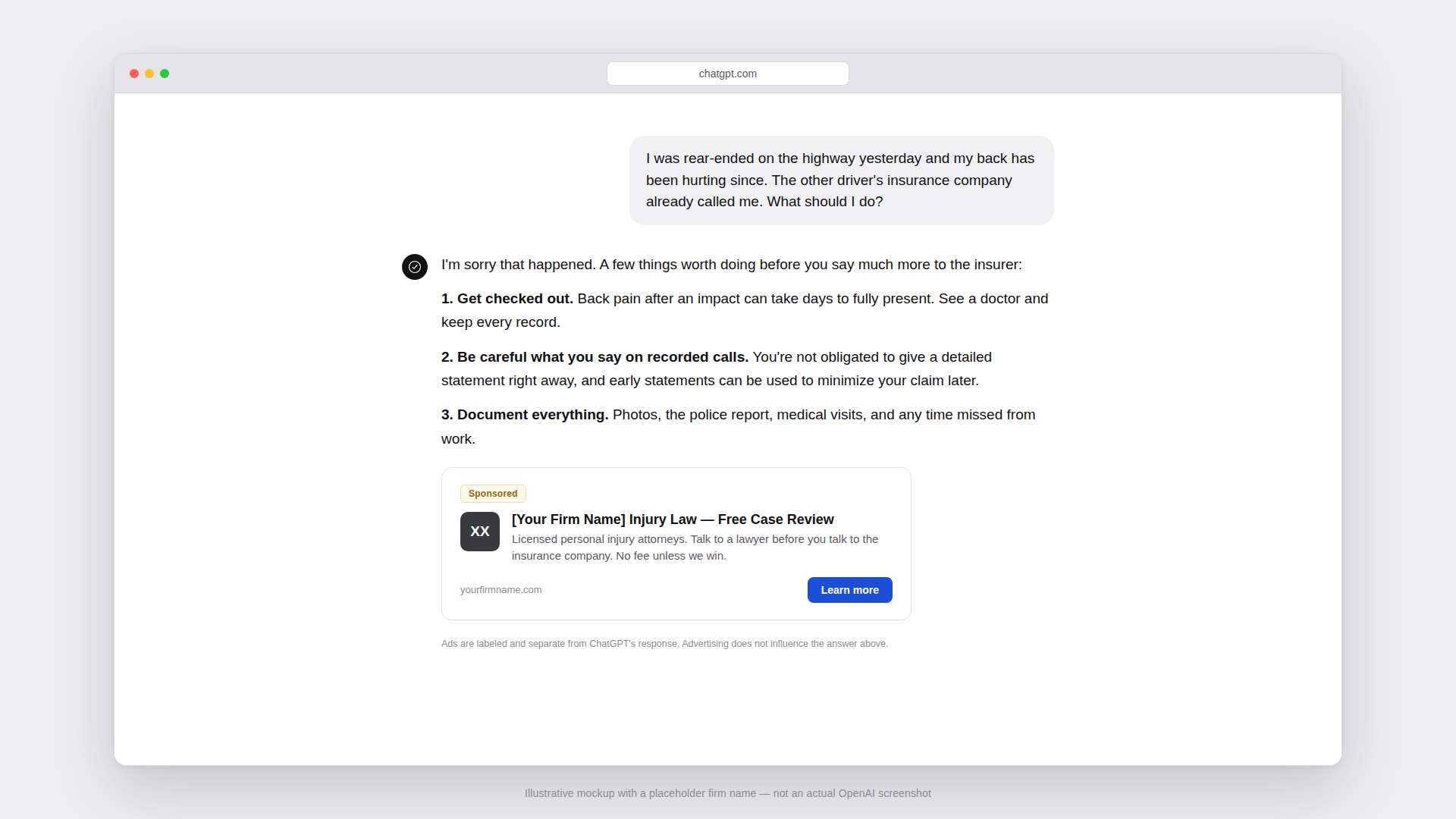
Ads appear as a distinctly labeled “Sponsored” card below ChatGPT’s response, not inside the answer itself, and not styled to look like part of the underlying product. They only reach people on ChatGPT’s Free and Go tiers; Plus, Pro, Team, Business, and Enterprise subscribers do not see ads at all, which is worth keeping in mind when you think about who your ideal client actually is and which plan they are likely using.
Even for an approved legal advertiser, ads will not appear inside what OpenAI calls “sensitive user contexts”: conversations involving personal, high-stakes, or emotionally vulnerable situations. In practice, that means you should not expect your ad to show up inside someone’s most raw, emotional description of what happened to them.
What This Looks Like Across Practice Areas
The same ad format behaves differently depending on what a potential client is actually asking. A few examples:
Does OpenAI’s Approval Override Your State Bar’s Rules?
No, and this is the part most coverage of this update glosses over.
OpenAI’s permission is a platform policy, not a substitute for your bar’s attorney-advertising rules. A few things stay true no matter what OpenAI allows:
- Truthfulness and disclaimers still apply. Standard rules against misleading claims, plus any “Attorney Advertising” disclaimer your state requires, apply to both the ad copy and the landing page it links to.
- Space is tight. Fitting a required disclaimer into a short ad card is a real creative constraint you will need to plan for, not an afterthought.
- Testimonials and outcome claims need extra care. OpenAI’s own baseline standards already prohibit exaggerated results and false endorsements, which happens to overlap with most bar rules, but the two are not identical. Check both.
- Solicitation rules are genuinely untested territory here. Some states restrict targeted solicitation of people known to need specific legal help within a set window after an incident. Conversational ad placement is new enough that your state’s ethics opinions may not directly address it yet.
Have your ad copy and landing page reviewed by bar or ethics counsel before your first campaign goes live, especially in states with stricter advertising rules.
How to Get Your Firm Approved
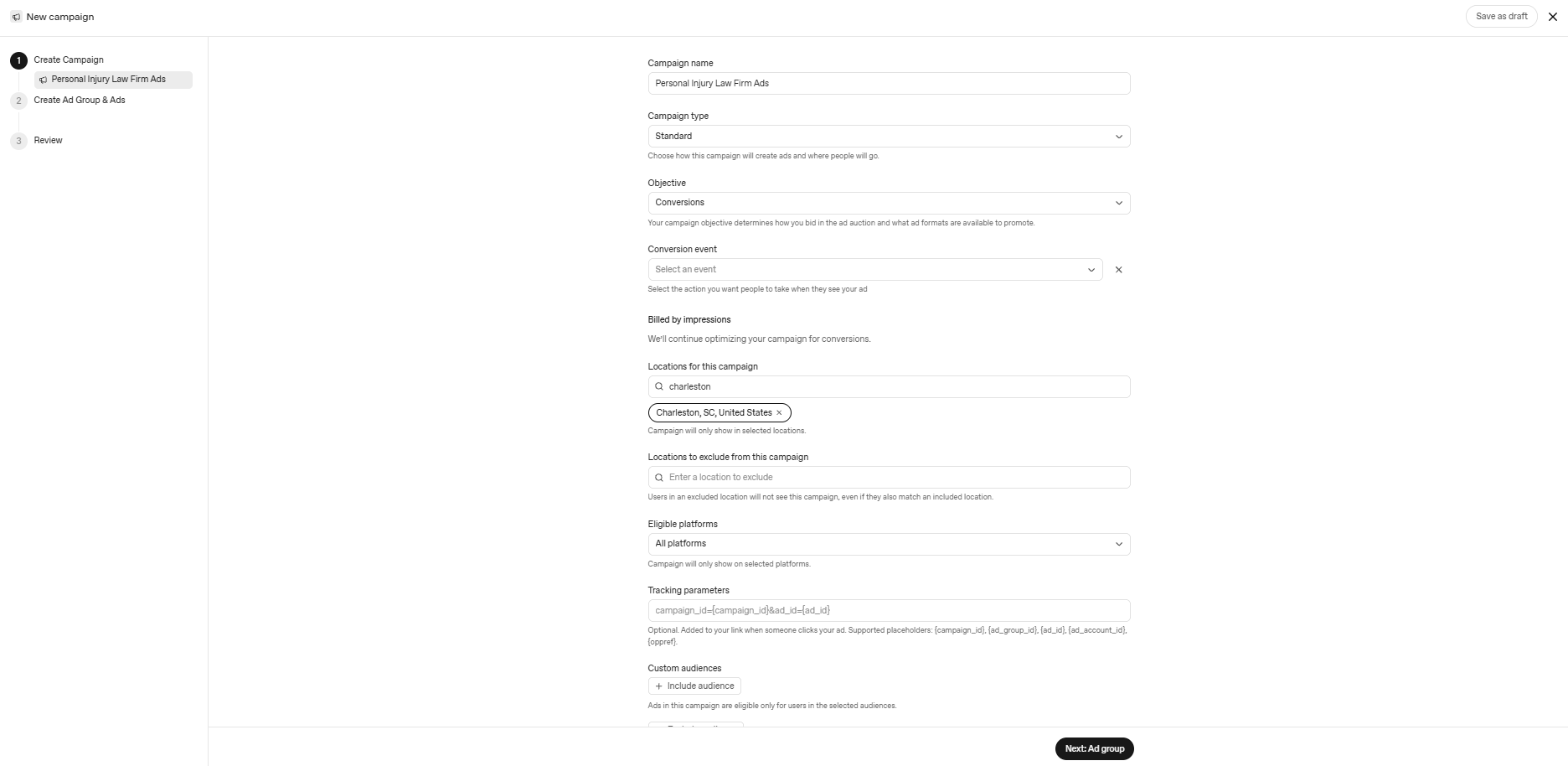
- Create an advertiser account in ChatGPT Ads Manager and complete business verification.
- Submit your bar license number and the jurisdiction(s) where you are licensed.
- Set geographic targeting to match where you are actually licensed to practice.
- Write ad copy and a landing page that satisfy both OpenAI’s standards and your bar’s advertising rules.
- Submit for review. Expect manual review, since legal is a restricted category.
- Once live, monitor delivery and lead quality. OpenAI can still pause or decline delivery at its discretion.
What It Might Cost
OpenAI has not published legal-specific pricing, and this category only opened days before this article, so treat any number here as an early signal, not a guarantee.
- Platform pricing has moved fast: roughly $60 CPM with a $200,000 minimum at the February 2026 launch, dropping to around $25 CPM with no minimum once self-serve opened in May, alongside CPC bidding with category-based floors of about $3 to $5.
- Early reports from agencies running campaigns in law-adjacent categories put clicks in the $2 to $5 range, well below the $50 to $100 or more that many firms pay per click on Google Ads for competitive practice areas.
- Confirm current numbers directly in your own Ads Manager account before setting a budget. Self-reported figures from other advertisers are a starting point, not a quote.
Should Your Firm Test This Now?
Good candidates: firms with an existing intake process and conversion tracking, practice areas named directly in the policy, and enough budget to treat this as a real test rather than a one-time experiment.
Less ready: firms without a compliance review process in place, or without a landing page that can be updated quickly if OpenAI requests changes.
The temporary advantage: because this opened so recently, most law firms have not applied yet. That is a real, if likely short-lived, edge for firms that move now.
Paid Placement Is Half the Picture
A ChatGPT ad gets your firm in front of someone right now. It does not make ChatGPT recommend your firm organically the next time someone asks a similar question without an ad in view. Both matter: paid placement for immediate visibility, and organic AI visibility (SEO, AEO, and GEO work) for the moments no ad is shown at all, including the “sensitive context” conversations where ads never appear.
Getting approved involves real coordination: license verification, jurisdiction-accurate targeting, ad copy and a landing page that satisfy both OpenAI and your bar, and ongoing compliance monitoring as this policy keeps evolving. Our ChatGPT Ads for Law Firms service handles that process end to end, from verification through campaign launch and compliance review, so your team does not have to become an expert in ChatGPT Ads and legal-advertising ethics overnight.
FAQ: ChatGPT Ads for Law Firms
Can any law firm advertise on ChatGPT now?
Only if the advertiser is a licensed attorney in the jurisdiction where the ad will appear, and the offer falls within legal advice, representation, or the named practice areas. Approval is manual and case-by-case, so eligibility does not guarantee an immediate green light.
Do I need to give OpenAI my bar license number?
Yes, in practice. OpenAI’s advertiser policies require proof of your professional credentials for regulated categories like legal services, and geographic targeting needs to match your licensed jurisdiction.
What happens if my ad reaches someone outside a state where I am licensed?
That is treated as the advertiser’s responsibility, not OpenAI’s. Misrepresenting your service area or licensing eligibility can put your advertiser account at risk, not just the individual ad.
Can I use testimonials or case results in a ChatGPT ad?
Be cautious. OpenAI’s baseline standards already prohibit exaggerated claims and false endorsements, and most states' bars separately restrict or require disclaimers around testimonials and case results. Get bar-compliance review before publishing either the ad or its landing page.
How much do ChatGPT ads cost for law firms?
Legal-specific pricing is still emerging. Broader platform pricing has ranged from roughly $25 to $60 CPM and $3 to $5 or more per click, depending on bidding method. Confirm current numbers in your own Ads Manager account.
Will my ad show up in every legal-related ChatGPT conversation?
No. OpenAI excludes ads from “sensitive user contexts,” meaning emotionally vulnerable or high-stakes conversations, even for advertisers in approved categories like legal services.
Should I move my Google Ads budget to ChatGPT ads?
Not yet, for most firms. Google Ads and Local Services Ads remain the more mature, higher-intent channels. Treat ChatGPT ads as a separate, modest test budget while the platform, and the legal category specifically, is still maturing.
Final Thought
This policy is a few weeks old as of this writing, and it has already changed direction once this year. The firms that benefit most from it will be the ones that treat it as what it is: a real but young channel worth testing deliberately. It is not a replacement for the marketing fundamentals that still decide whether a lead actually becomes a client: SEO, reviews, and intake quality.
This article is for general informational purposes and is not legal advice. Confirm current policy details directly in ChatGPT Ads Manager, and consult your bar association or ethics counsel before launching any legal-services ad campaign.