


/icon%209.svg)
/icon%2010.svg)
/icon%2011.svg)
/icon%2012.svg)
/icon%2013.svg)
/icon%2014.svg)



If you searched Google recently and noticed a block of text sitting above the usual list of blue links, giving you a summarized answer before you even clicked anything, you already met the feature this article is about. It is called an AI Overview, and it has quietly become the biggest change to legal marketing since Google introduced the map pack for local searches.
Some lawyers have been watching this closely. Others have not registered what it is or why their partners keep bringing it up in meetings. Both groups need to understand it, because AI Overviews are changing how prospective clients find a lawyer, long before that client ever picks up the phone.
What an AI Overview Actually Is
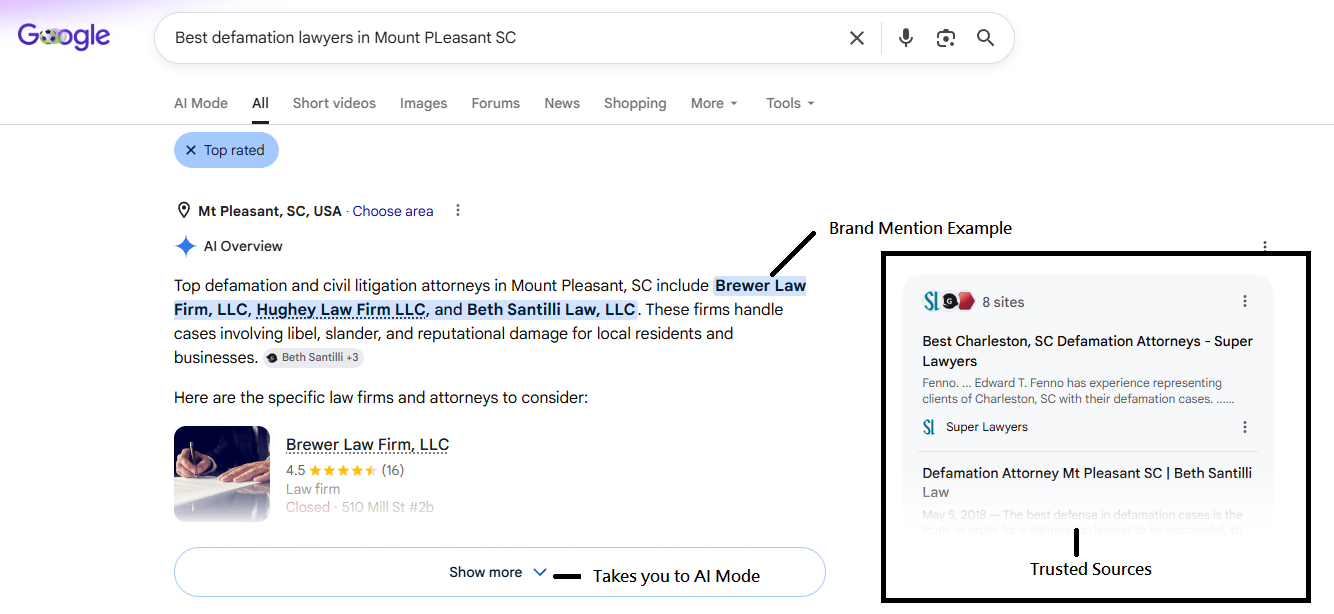
When someone searches "Best defamation lawyers in Mount Pleasant SC" or "how long do I have to file a personal injury claim in Charleston," Google no longer just hands them ten links and lets them figure it out. Instead, Google's AI reads across many web pages, pulls out what it considers the most useful information, and writes a short, direct answer right at the top of the results page. A few source links appear underneath, in small print, as the "evidence" for that answer.
The searcher gets their answer without clicking anywhere. That is the part that should get your attention.
Why This Changes the Math for Law Firms
For years, law firm marketing worked on a simple premise: rank high, get clicked, convert the click into a call. AI Overviews break that chain in two ways.
First, fewer people click through at all. When an AI Overview appears, a large share of searchers get their answer and move on. Research from Pew has found that people are roughly half as likely to click a traditional search result once an AI Overview appears on the page, and they almost never click the small citation links tucked inside the summary itself.
Second, and this is the part that surprises most managing partners, ranking first no longer guarantees you get cited. Google's AI Overview and the organic results below it are built by two different processes. A firm sitting in position one on the page can be completely absent from the AI Overview above it, while a smaller competitor with better structured content gets quoted directly. Traditional SEO rank and AI citation are related, but they are not the same contest anymore.
The upside is real, though. Clients who do click through from an AI Overview citation have usually already had their basic question answered. They are further along, better informed, and more likely to be a serious inquiry rather than someone still comparing options. Fewer clicks, but often better ones.
Being Cited Beats Being Ranked
This is the mental shift that matters most: your goal is no longer only to rank on the page. It is to become the source the AI trusts enough to quote.
Marketers have started calling this practice Generative Engine Optimization, or GEO, sometimes also called Answer Engine Optimization. The name is new. The underlying idea is straightforward. You are writing so a machine can lift a clean, accurate, well supported answer straight from your page and hand it to a person who needs a lawyer.
A few things tend to separate firms that get cited from firms that do not.
Consistency across the web. Google's AI is more confident citing a firm when your name, address, and phone number match exactly across your website, your Google Business Profile, your state bar listing, and directories like Avvo, Justia, and FindLaw. Small inconsistencies, an old suite number here, a missing middle initial there, make it harder for the system to confirm you are who you say you are.
Direct answers, not buildup. If a page asks "What is the statute of limitations for a car accident in New York?" the answer needs to show up in the first sentence or two, in plain language, before you get into the nuance. AI systems tend to pull the first clear, self-contained answer they find. Bury it under three paragraphs of introduction and a competitor's shorter, more direct page gets quoted instead.
Depth on your actual practice areas. A single blog post rarely earns a citation on its own. Pages that sit inside a well organized cluster of related content on the same topic, an estate planning firm covering wills, trusts, probate, and powers of attorney with real depth on each, tend to be treated as more authoritative than a single scattered post.
Structured data behind the scenes. This is technical, and your web developer or marketing team should own it, but schema markup (a way of labeling your content so machines can read it precisely) genuinely helps. It tells search engines exactly who your attorneys are, what you practice, and where you are located, instead of leaving the system to guess.
Making sure the AI can actually read your site. Some websites are configured, often unintentionally, to block the crawlers that AI systems use to gather information. If your site's robots.txt file is blocking those crawlers, you are invisible to this entire channel no matter how good your content is. This is a five minute check worth having your developer run today.
Can You Trust What the AI Says About Your Practice Area?
Here is the part every lawyer should read twice.
Independent research on Google's AI Overviews has found accuracy in the high 80s to low 90s percent range on general knowledge questions. That sounds acceptable for a weather forecast. It is a genuinely uncomfortable number when the topic is a filing deadline, an element of a claim, or a description of someone's legal rights. The same research has also found that a meaningful share of the claims inside these summaries are not actually supported by the sources cited underneath them, meaning the AI sometimes states something with total confidence that its own listed source does not say.
This cuts two ways for a law firm.
First, if the AI Overview is wrong about something and you happen to be the cited source, that matters for your reputation. It is worth periodically searching your own practice area questions and checking what the AI says, and whether it is citing you accurately.
Second, if you or your team ever use AI tools to help answer legal questions in your own work, this same accuracy problem applies to you directly. Which brings us to the part of this topic that has nothing to do with marketing.
The Ethics Side: Using AI Is Not the Same as Being Cited by AI
Everything above concerns how AI tools describe your firm to the public. There is a separate and equally important question: how you and your staff use AI tools in the practice of law itself, and what your professional obligations are when you do.
The American Bar Association addressed this directly in Formal Opinion 512, issued in July 2024. It does not create new rules. It simply confirms that your existing ethical duties apply fully to generative AI, and it is worth knowing the basics even if you never touch these tools personally, because someone on your team probably will.
Competence. You are expected to understand, at a working level, what a given AI tool can and cannot do before you or your staff rely on it. You do not need to understand the underlying technology like an engineer would. You do need to know that these tools can produce confident sounding fabrications, including fake case citations, and that every output requires independent verification. The sanctions in Mata v. Avianca, where attorneys submitted a brief built on cases that did not exist, remain the cautionary tale here for a reason.
Confidentiality. Client information should not be typed into a general public AI tool unless you know exactly how that platform handles and stores what you give it. Several state bars, including Florida and Arizona, have advised treating any AI platform the way you would treat a third party vendor: vet it, understand its data practices, and get informed consent before using it on anything sensitive.
Fees. You cannot bill a client for three hours of drafting time when an AI tool produced the first draft in five minutes. Learning to use a tool generally is treated as firm overhead, not billable time, unless a client specifically asked you to use a particular tool for their matter.
Supervision. If you are a managing or supervising attorney, you are responsible for making sure everyone in your office, associates and staff alike, understands the firm's AI policies and the risks involved. The attorney who signs and files the document remains accountable for what is in it, regardless of what tool helped write it.
Disclosure. States are not aligned on this yet. Some, like Florida, lean toward recommending written client consent before using AI on client matters. Others treat it more contextually. If you practice across state lines, it is worth checking your specific state bar's guidance rather than assuming the national baseline covers you everywhere.
None of this should discourage you from using these tools well. It is simply the seatbelt that comes with the car.
Where to Start
You do not need to overhaul your entire marketing strategy or your entire practice this week. A reasonable starting point looks like this.
- Search yourself the way a client would. Type in the questions your prospective clients actually ask, "how do I file for divorce in my state," "what happens after a DUI arrest," whatever fits your practice, and see what the AI Overview says. Note whether your firm shows up, and whether the information is accurate.
- Check your name, address, and phone number everywhere they appear online. Fix any inconsistency you find. This is tedious, unglamorous work, and it genuinely moves the needle.
- Look at your five highest traffic pages. Do they answer the core question in the first two sentences? If not, that is worth rewriting before you write anything new.
- Ask whoever manages your website whether AI crawlers are blocked. It takes minutes to check and it is often the single biggest reason a well written page gets no citations at all.
- Put a short AI use policy in writing for your firm, even a one page version covering what tools are approved, what should never be typed into them, and who reviews the output. If you do not have one yet, you are not alone. Plenty of firms are behind on this, but that is exactly why it is worth getting ahead of it now.
AI Overviews are not a passing trend to wait out. They are becoming the front door of legal research for a large share of the public, and the firms that understand how that door works, both as a marketing channel and as a professional responsibility question, are the ones who will still be found, still be trusted, and still be compliant five years from now.