


/icon%209.svg)
/icon%2010.svg)
/icon%2011.svg)
/icon%2012.svg)
/icon%2013.svg)
/icon%2014.svg)



For decades, law firms approached online reputation with a simple formula. They focused heavily on increasing the number of Google reviews, improving Google Business Profile ratings, and boosting local map rankings. Those factors absolutely still matter. However, the foundational mechanics of legal search behavior have completely changed.
Google has fundamentally altered its search interface for the first time in 25 years. Users are no longer restricted to typing a query, clicking multiple website links, and manually comparing law firms. Today, prospective clients bypass traditional search entirely. They turn to ChatGPT, Google AI Mode, Claude, Gemini, and Perplexity, asking highly specific, conversational questions.
Instead of searching "personal injury lawyer Charleston," they ask, "Who is the best personal injury lawyer in Charleston who communicates well with clients?" or "Which local law firm has the most trusted reputation for handling car accidents?"
AI engines do not just provide links. They summarize, compare, interpret, and recommend law firms using reputation data pulled from across the internet. In this new landscape, reviews are no longer just a local SEO factor. They are the primary data source for AI recommendation systems, trust evaluation, and visibility algorithms.
The Paradigm Shift: From Clicks to AI Synthesis
Historically, legal SEO was a game of proximity, relevance, and traditional prominence. A high volume of positive reviews directly influenced map rankings. Once a firm ranked, the website’s job was to convert the click.
Today, the evaluation process happens before a user ever sees a website. AI interfaces bring the decision-making phase directly into the search results. When an AI tool evaluates your law firm, it reads and synthesizes public sentiment from across the web. If your firm lacks a dense, detailed, and consistent online reputation, large language models will simply bypass you in favor of a competitor with richer data.
Why Reputation Governs AI Visibility
A law firm may possess exceptional litigation skills and an unparalleled track record of verdicts. However, AI engines cannot evaluate legal strategy or independently verify courtroom prowess. They rely entirely on public reputation signals.
AI visibility increasingly depends on these aggregated trust signals. The models synthesize the collective voice of your past clients to define your entity’s reputation. If a competing firm has a wealth of detailed client feedback praising their responsiveness, empathy, and professionalism, the AI will recommend them over a highly skilled but under-reviewed practice.
How Google AI Mode Deploys Review Data
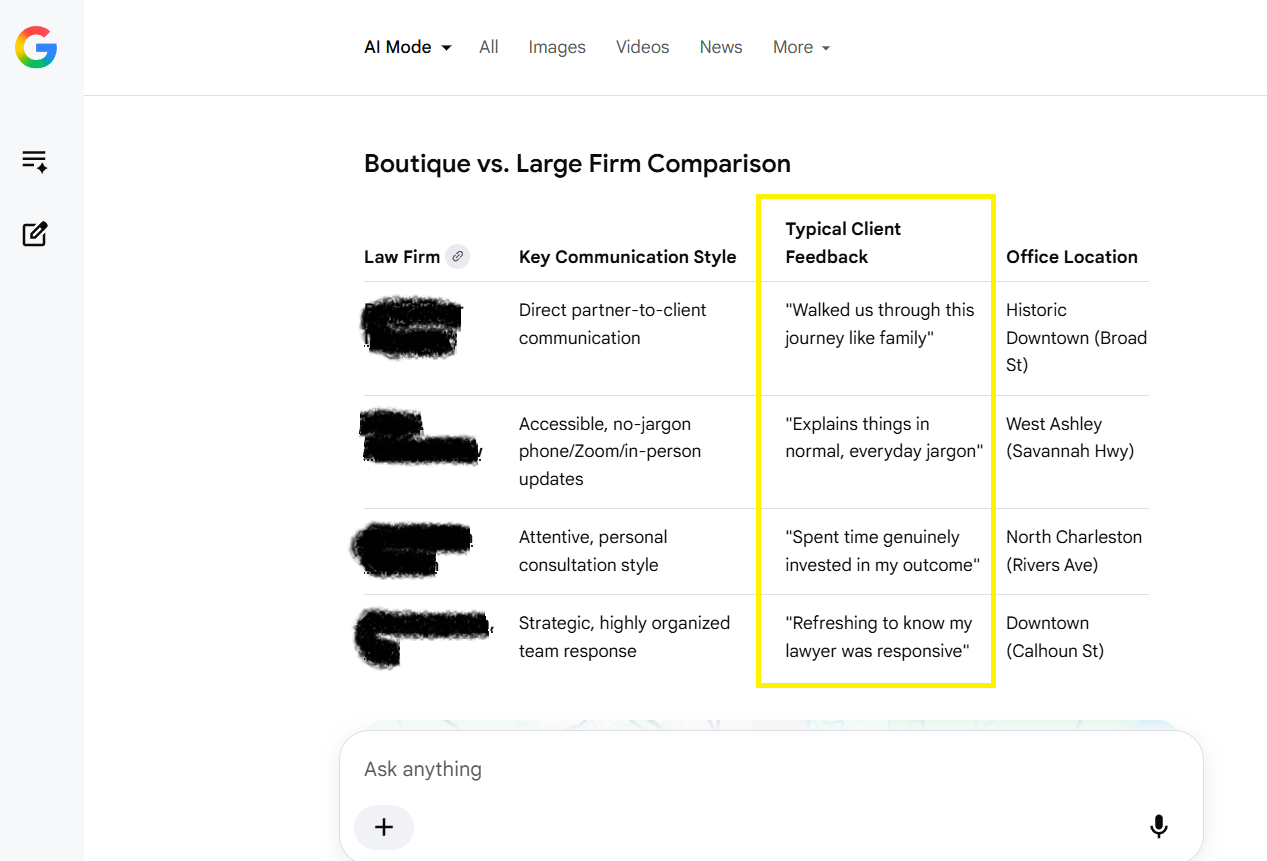
Google AI Mode has introduced an unprecedented level of transparency to lawyer marketing. When users search for top representation, the AI frequently displays law firms in a side-by-side comparison.
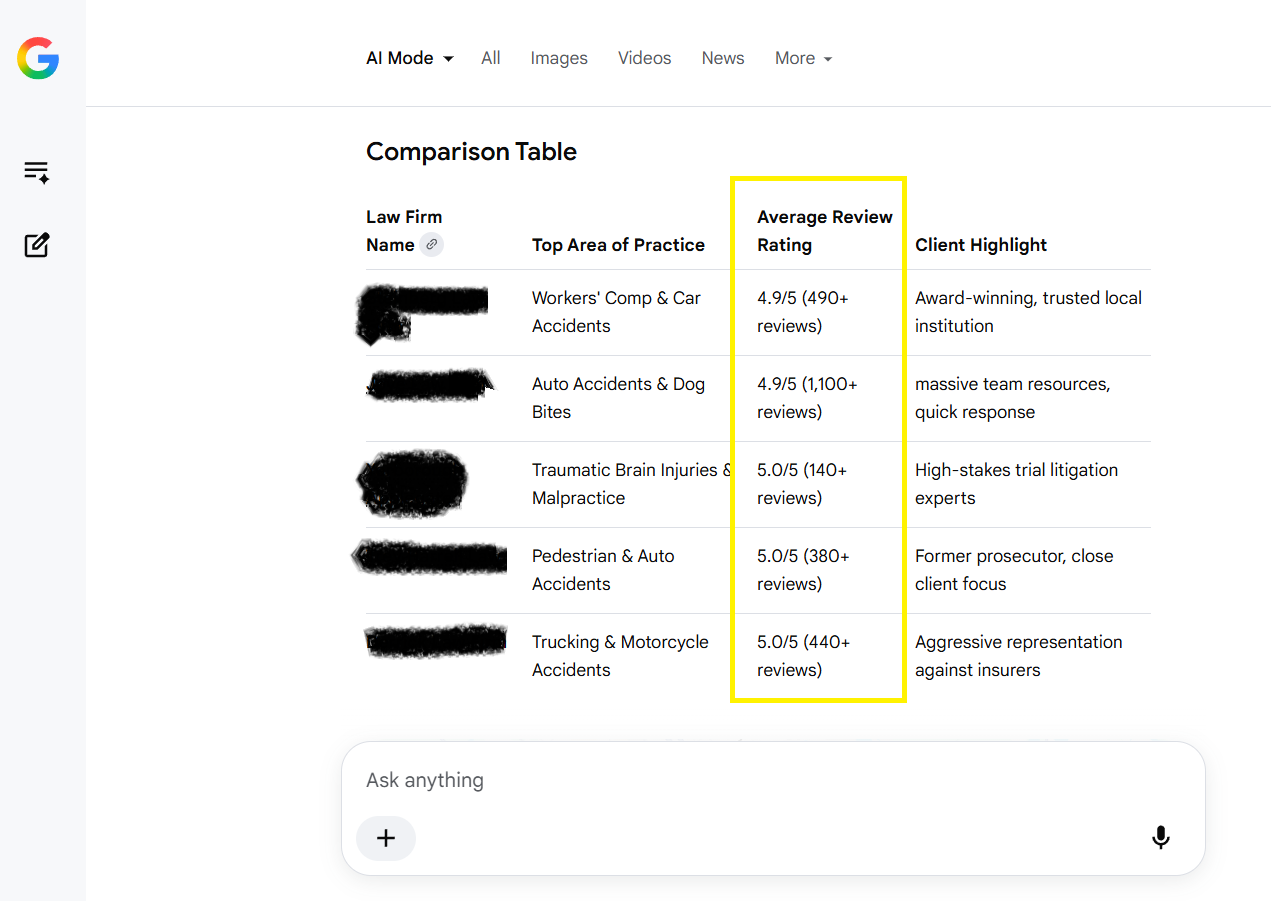
During this process, Google actively extracts review snippets and uses them as direct comparison metrics. The AI surfaces the strengths and weaknesses of specific attorneys based entirely on client narratives. It highlights summarized reputation insights such as aggressive representation, transparent billing, or settlement speed. Users are now making hiring decisions based on these AI-generated summaries without ever clicking through to read a full attorney biography.
Ask Maps & Natural Language Reputation Summaries
Google’s Ask Maps feature fundamentally changes how local feedback is processed. Rather than relying on a numerical star rating, Ask Maps ingests reviews from multiple sources and explains a law firm’s reputation in natural language.
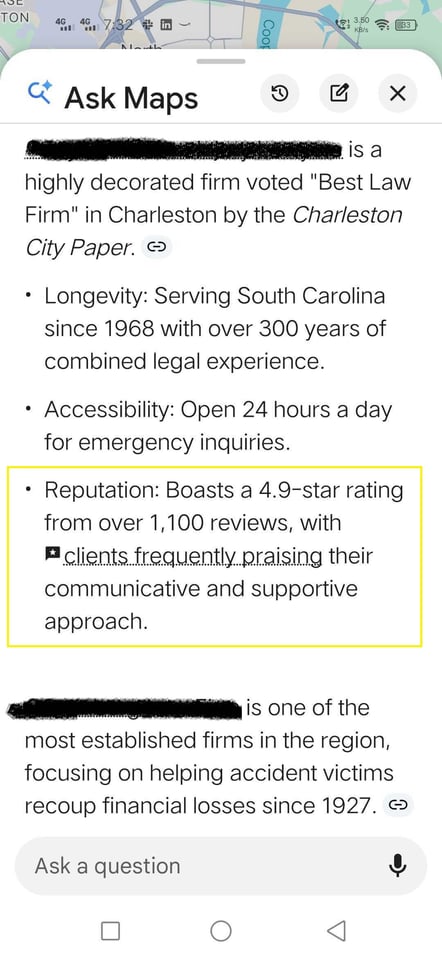
The AI identifies patterns across reviews. It evaluates the text for recurring themes, including:
- Responsiveness and communication speed
- Aggressiveness in negotiations
- Professionalism and staff courtesy
- Overall client satisfaction
- The realities of the settlement experience
On mobile AI search interfaces, Google highlights both the review count and a synthesized summary of the firm's reputation. AI systems prioritize semantic patterns over raw numbers. A firm with 40 deeply detailed reviews explaining excellent communication will consistently outrank a firm with 100 generic five-star ratings.
Why Detailed Reviews Outperform Generic Feedback
In the realm of AI search optimization, not all reviews carry equal weight. A review stating simply "Great lawyer" provides almost zero contextual data for an algorithm.
Detailed reviews provide the semantic relevance AI engines require to match a law firm with nuanced user queries. A review stating, "This law firm handled my commercial trucking accident perfectly, the attorney was incredibly responsive, and they communicated every step of the litigation clearly," feeds the AI exact keywords, entity relationships, and sentiment data. AI systems learn context from this granular language. This data allows the engine to confidently recommend the firm when a user asks an AI for a "responsive trucking accident lawyer."
The Ecosystem of Trust: Sources AI Engines Value
AI systems do not restrict their data collection to Google. Review aggregation across platforms is a mandatory component of modern online reputation management. AI engines pull trust signals from:
- Google Business Profile
- Avvo
- Justia
- Expertise.com
- Niche legal directories
- Yelp
- Local business citations
- Third-party review websites
The authority of the source matters heavily. Popular, trusted legal directories carry additional weight in AI-generated summaries. Maintaining accurate, active, and highly rated profiles across the broader legal ecosystem establishes the core trust signals these algorithms require.
What Law Firms Must Do Immediately
Adapting to AI search requires a proactive, operational shift in how a law firm handles client feedback. Here is what firms must implement to secure their future visibility.
Systematize Review Acquisition
Law firms must actively encourage clients to leave reviews. This cannot be an afterthought. Firms should build automated review follow-ups into their intake-to-review workflows. Integrating review requests into your CRM or practice management software ensures feedback collection becomes a seamless part of firm operations.
Coach Clients for Detail
Educate your clients on the value of a descriptive review. Prompt them to discuss specific aspects of their experience, such as communication, responsiveness, professionalism, and trust. The more context the client provides, the better the AI can categorize and recommend your firm.
Execute Strategic Review Responses
Review responses are highly visible data points. Law firms must abandon generic responses like "Thank you for your feedback." Responses should add meaningful context, reinforce professionalism, and naturally reference practice areas. A strategic response looks like: "Thank you for trusting our team with your personal injury case. We are pleased that our attorneys could secure a fair settlement and maintain transparent communication with you throughout the litigation."
Embed Trust Signals on Your Website
Reviews should not live exclusively on third-party platforms. Integrate reviews into your website through dedicated testimonial sections and reputation-focused landing pages. Implement proper schema markup so AI crawlers can easily identify, read, and index your embedded review content.
Optimize All Legal Directory Profiles
Incomplete profiles generate negative trust signals. Law firms must claim and optimize their presence on Avvo, Justia, Expertise.com, and local business directories. Consistency across these platforms validates your firm's authority to AI evaluation algorithms.
Leverage Local Recognition Programs
AI systems interpret third-party validation as a strong trust signal. Participating in the Charleston Choice Awards, local business recognitions, and legal community awards provides authoritative data points that AI engines use to verify your prominence.
Common Mistakes Lawyers Make
The most common strategic failure is treating reputation management as a passive exercise. Firms often ignore third-party directories, assuming only Google dictates visibility. Many attorneys deploy generic, robotic responses to the reviews they do receive, wasting a prime opportunity to feed context back to the AI. Ultimately, firms that fail to implement an automated review generation system will lose market share to competitors who understand that visibility now requires constant, high-quality data.
The Future of Law Firm Visibility
The evolution of lawyer marketing is heavily dependent on proving trust at scale. As AI search interfaces become the primary method for finding legal counsel, the algorithms will become increasingly sophisticated at identifying genuine, context-rich client experiences. Law firms that build a dominant, multi-platform reputation strategy today will command the AI recommendations of tomorrow.