


/icon%209.svg)
/icon%2010.svg)
/icon%2011.svg)
/icon%2012.svg)
/icon%2013.svg)
/icon%2014.svg)



For years, law firm websites were built around one primary goal: get found on Google.
That meant building practice area pages, targeting local searches, improving technical SEO, earning authority, and making the site easy for Google to crawl.
Those fundamentals still matter.
But AI Search has changed the question.
A potential client can now ask ChatGPT, Google AI Mode, Perplexity, or another AI search tool:
"Who are the best personal injury lawyers in Charleston for a truck accident?"
The system has to find information about law firms, understand what they do, determine where they practice, and decide which sources are credible enough to reference.
So the question is no longer just:
Can Google find my website?
It is:
Can search systems understand what my firm does, where we practice, and why they should trust us?
Google's own guidance is important here. There is no separate set of "AI SEO" requirements for appearing in its generative search features. The same core SEO and quality principles still apply.
That means law firms do not need to build a website for AI.
They need to build a website that is exceptionally clear, useful, accessible, and trustworthy.
1. If the Page Does Not Exist, AI Has Nothing to Find
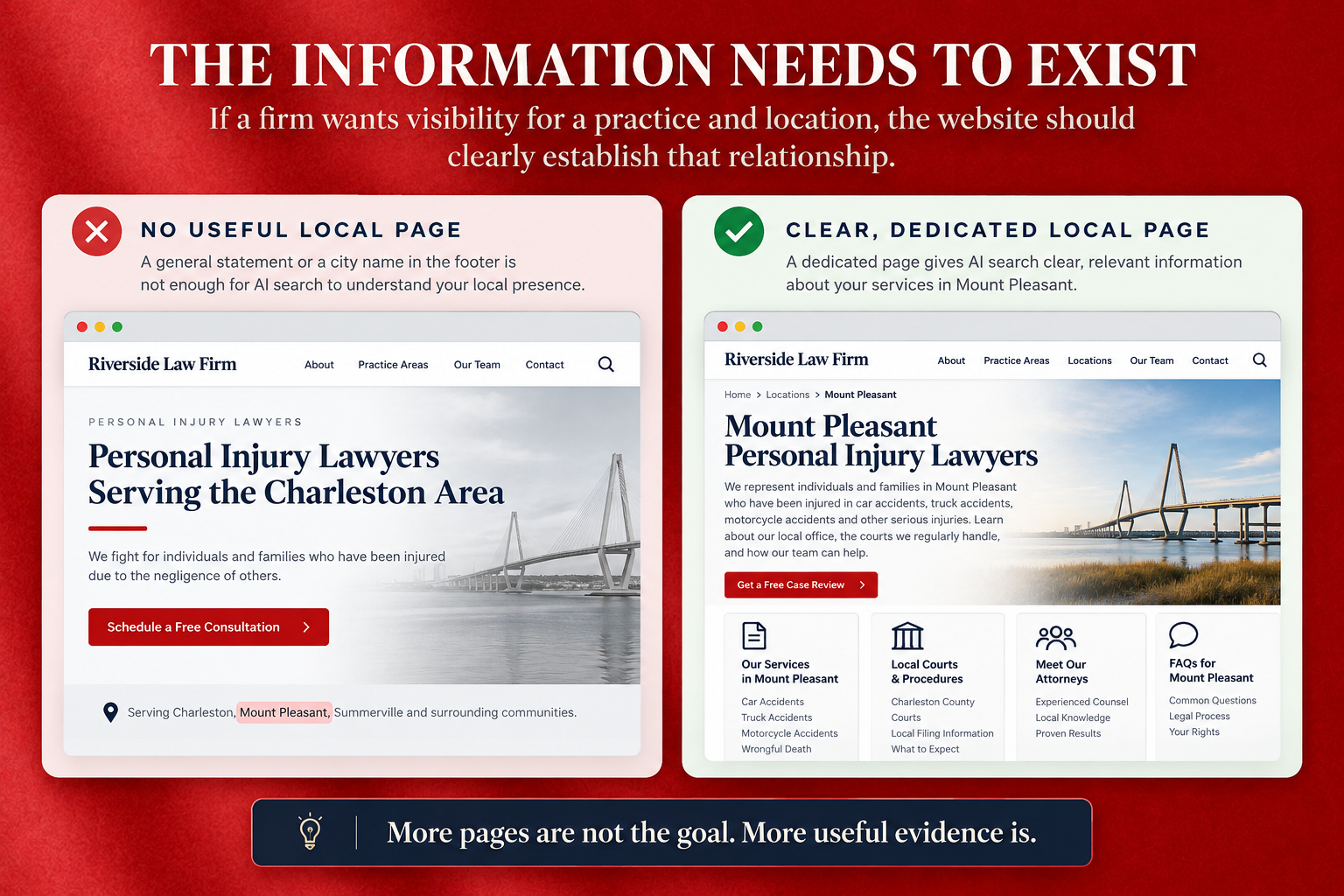
Consider a law firm that wants to attract personal injury clients in Mount Pleasant.
Its website might say:
- "We serve the Charleston area."
- "We represent clients throughout South Carolina."
- Mount Pleasant appears in the footer.
- The firm's Google Business Profile lists a Charleston office.
But there is no meaningful page explaining the firm's personal injury services in Mount Pleasant.
To the firm, the connection is obvious.
To a search system, there is very little first-party content that directly establishes that relationship. AI systems need retrievable information they can use to answer specific queries.
A useful location page can make that relationship clear
It might include:
- Services offered in that location
- Attorneys who handle those matters
- Relevant courts or local procedures
- Office and meeting information
- Location-specific FAQs
- Relevant, compliant case experience
- Links to related practices and attorneys
What it should not be is a template where "Charleston" is replaced with "Mount Pleasant."
Google warns against creating scaled pages primarily to manipulate Search or generative AI visibility.
The goal is not more pages. The goal is more useful evidence.
2. Your Website May Look Great to People and Still Be Hard for AI to Read
This is where web development becomes part of AI Search strategy.
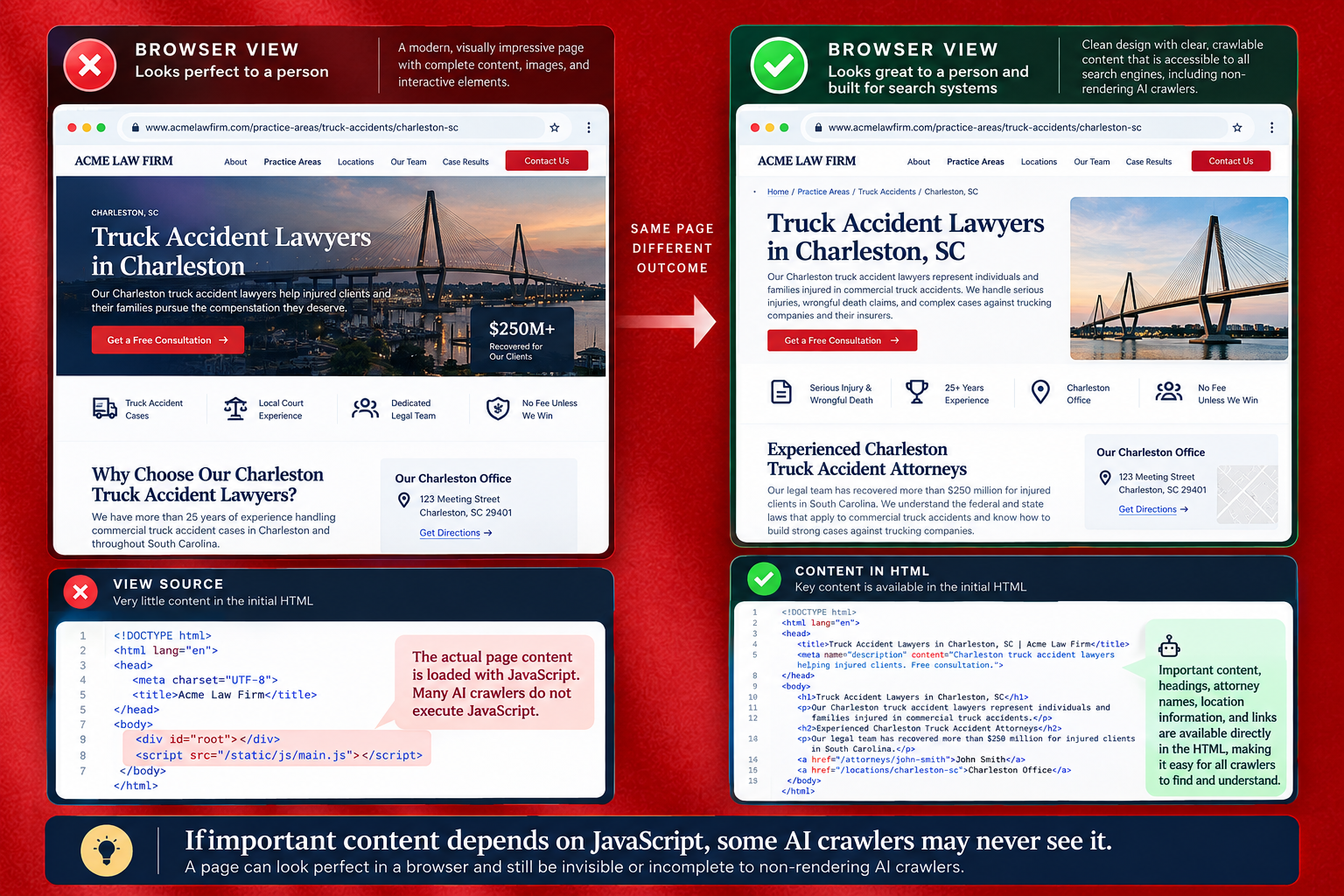
A website can display a complete page in a browser while delivering very little useful content in its initial HTML.
That can happen when critical content depends heavily on client-side JavaScript.
Google can process JavaScript. However, industry testing from Vercel and MERJ found that several major AI crawlers did not execute client-side JavaScript in their testing. Their recommendation was to keep important content available in HTML while using JavaScript for interactive features and enhancements.
For a law firm website, critical information should be available without relying entirely on JavaScript.
That includes:
- Practice area content
- Location information
- Attorney names and credentials
- Main headings and copy
- Internal links
- Contact information
- Important metadata
The development solution may involve server-side rendering, static generation, or appropriate pre-rendering.
The principle is simpler:
JavaScript can enhance the website. It should not be responsible for making the core information exist.
A basic test is to view the page source and compare it with the rendered page.
If the browser shows a complete practice area page but the source contains very little actual content, your development team should investigate.
3. Your Website Architecture Should Explain the Firm
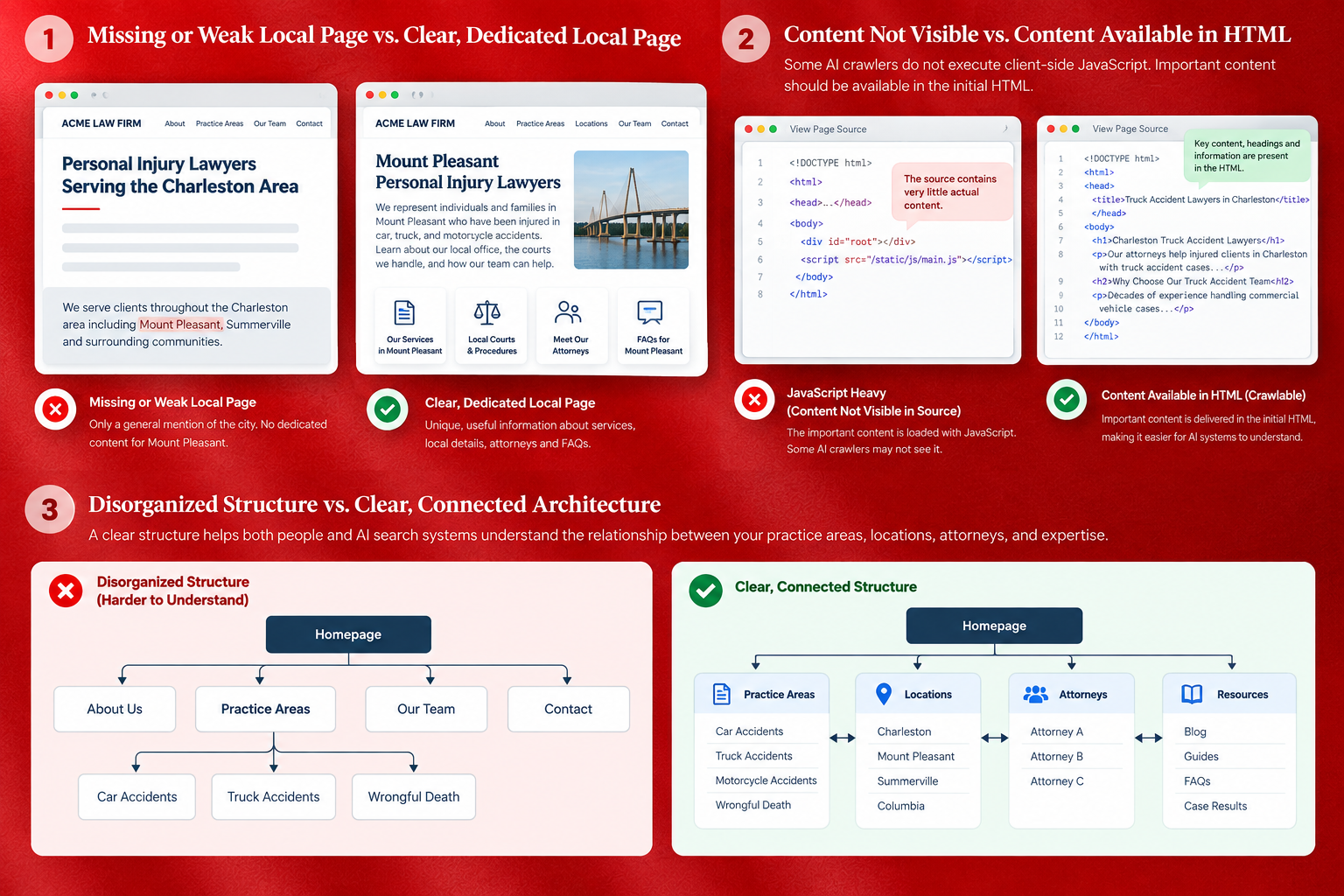
A strong law firm website should make the firm's structure easy to understand.
The key relationships are:
Firm → Practice Area → Location → Attorney → Expertise
A well-planned site might look like this:
Practice Areas
- Personal Injury
- Car Accidents
- Truck Accidents
- Wrongful Death
Locations
- Charleston
- Mount Pleasant
- Columbia
- Greenville
Attorneys
- Attorney A
- Attorney B
- Attorney C
Resources
- Legal Guides
- FAQs
- Case Results
- Videos
These sections should be connected through relevant internal links.
- Practice pages should connect to the attorneys who handle those matters.
- Location pages should connect to relevant practices and attorneys.
- Attorney biographies should explain practice areas and jurisdictions.
- Resources should connect back to the practices and locations they support.
This creates a clearer path for visitors and gives search systems a better understanding of how the firm's pages relate to one another. Your research specifically recommends connecting practice hubs, locations, attorney bios, and related resources through internal HTML links.
4. Your Website Needs to Prove the Firm Is What It Says It Is
AI Search does not just need information.
It needs information it can reasonably trust.
That matters even more for legal content, where expertise and accuracy carry significant weight. Google's guidance treats legal information as a high-trust category and emphasizes reliable, expert content.
A strong law firm website should make that expertise visible through facts such as:
- Attorney names and biographies
- Bar admissions and jurisdictions
- Relevant courts
- Practice areas
- Professional experience
- Legal authorities and citations
- Current legal information
- Original analysis
- Relevant case experience, where permitted
This also changes how law firms should think about content.
Instead of asking:
"How many blog posts should we publish?"
Ask:
"What can we publish that demonstrates actual legal expertise?"
That could be:
- A guide to a local court process
- An explanation of a state law
- An attorney-led video with a transcript
- A jurisdiction-specific FAQ
- An explanation of how a recent legal development affects clients
The strongest legal content is not simply optimized for search.
It is specific, current, useful, and credible.
5. Make Important Information Easy to Find
AI Search does not replace technical SEO.
It makes the fundamentals more important.
Your important pages should be:
- Crawlable
- Indexable
- Internally linked
- Included in the XML sitemap
- Free from accidental noindex directives
- Accessible without unnecessary technical barriers
Critical information should not exist only inside images, PDFs, or interactions that require JavaScript to load content after a click.
The same applies to performance.
A modern law firm website should still be:
- Fast on mobile
- Stable
- Easy to navigate
- Accessible
- Built with clean URLs and proper redirects
- Structured with logical headings
Do not make a search system work harder than necessary to understand your firm.
6. Structured Data Can Clarify Your Firm, But It Is Not an AI Shortcut
There is a lot of discussion around "AI schema."
Law firms should approach it carefully.
Google says there is no special schema required for AI Overviews or AI Mode. Structured data can still help search engines understand entities and support other search features, but it needs to accurately reflect the visible content on the page.
For a law firm, structured data may describe:
- The firm
- Offices
- Attorneys
- Legal services
- Articles
- Breadcrumbs
But schema cannot fix weak content.
It cannot turn a thin city page into a useful resource.
It cannot create expertise that the website does not demonstrate.
Use structured data to clarify what is already true, not to manufacture relevance.
7. Your Website Is the Foundation, Not the Entire AI Search Strategy
Your website is one source of information about your firm.
It is not the only one.
AI systems may also encounter:
- Google Business Profile
- Legal directories
- State bar profiles
- Reviews
- Professional organizations
- News coverage
- Other authoritative websites
That makes consistency important.
Your firm name should match across platforms.
Your attorney names should match.
Your office information should match.
Your practice areas and credentials should be accurate everywhere.
Research in your brief also found that legal directories can play a significant role in recommendation-style AI searches, while firm websites can be strong sources for specific legal questions.
Think of the roles this way:
Your website explains the firm.
Your external profiles reinforce the firm.
Both matter.
What Law Firm Owners Should Ask Their Web Team
You do not need to become a developer to evaluate whether your website is ready for AI Search.
Ask your web and SEO team:
- Do we have useful pages for the practice areas and locations that matter to our firm?
- Is our important content available in the initial HTML, or does it depend on JavaScript?
- Can the search crawlers we want to reach our site without being blocked by robots.txt, security software, or our CDN?
- Do our internal links clearly connect practices, locations, attorneys, and resources?
- Does our content show who wrote or reviewed it and why that person is qualified to speak on the subject?
- Does our website match our Google Business Profile and other authoritative profiles?
- Are we measuring whether AI systems are actually finding and citing our website for important searches?
These questions are far more useful than asking whether your website has an "AI SEO feature."
The New Standard for a Law Firm Website
AI Search is changing how people discover law firms.
It is not changing what makes a law firm website valuable.
A strong website still needs to make five things clear:
- Who you are
- What you do
- Where you practice
- Who handles the work
- Why your information should be trusted
The difference is that those answers now need to be clear enough for both a potential client and an AI system to understand.
That is why the answer is not to bolt an "AI Search layer" onto an outdated website.
The better approach is to build the foundation correctly:
Clear architecture. Useful content. Accessible HTML. Meaningful local pages. Strong attorney information. Consistent business data. Sound technical development.
Google's own guidance supports this broader approach. There is no secret AI markup that replaces the fundamentals.
The law firm websites best prepared for AI Search will not be the ones built for AI.
They will be the ones built exceptionally well in the first place.