

/icon%209.svg)
/icon%2010.svg)
/icon%2011.svg)
/icon%2012.svg)
/icon%2013.svg)
/icon%2014.svg)



We've been developing a framework for what makes personal injury content citable in AI Overviews: real cited sources, jurisdiction-specific detail, named and credentialed authorship, a direct answer instead of a preamble. The obvious next step was to check that framework against reality: pull the pages that are actually triggering AI Overviews for the highest-visibility South Carolina PI firms in our dataset, read them closely, and see what the ones doing it well actually have in common.
We selected 20 real, currently live pages: 10 practice-area pages and 10 blog or informational articles, each pulled from a keyword where an AI Overview appears, spread across the top of South Carolina's PI market. In keeping with how we've handled this data throughout this series, we're not naming which firm any individual page belongs to. The pattern matters more than the scoreboard, and several of the practices below are genuinely worth copying regardless of who's currently doing them.

What separates a strong practice-area page from a thin one
The weakest pages in our sample read like a template with a city name swapped in: a paragraph of empathy, a list of practice areas, a phone number, repeated almost verbatim across a dozen location variants. The strongest ones share a small number of specific habits.
They cite real, external, linkable sources
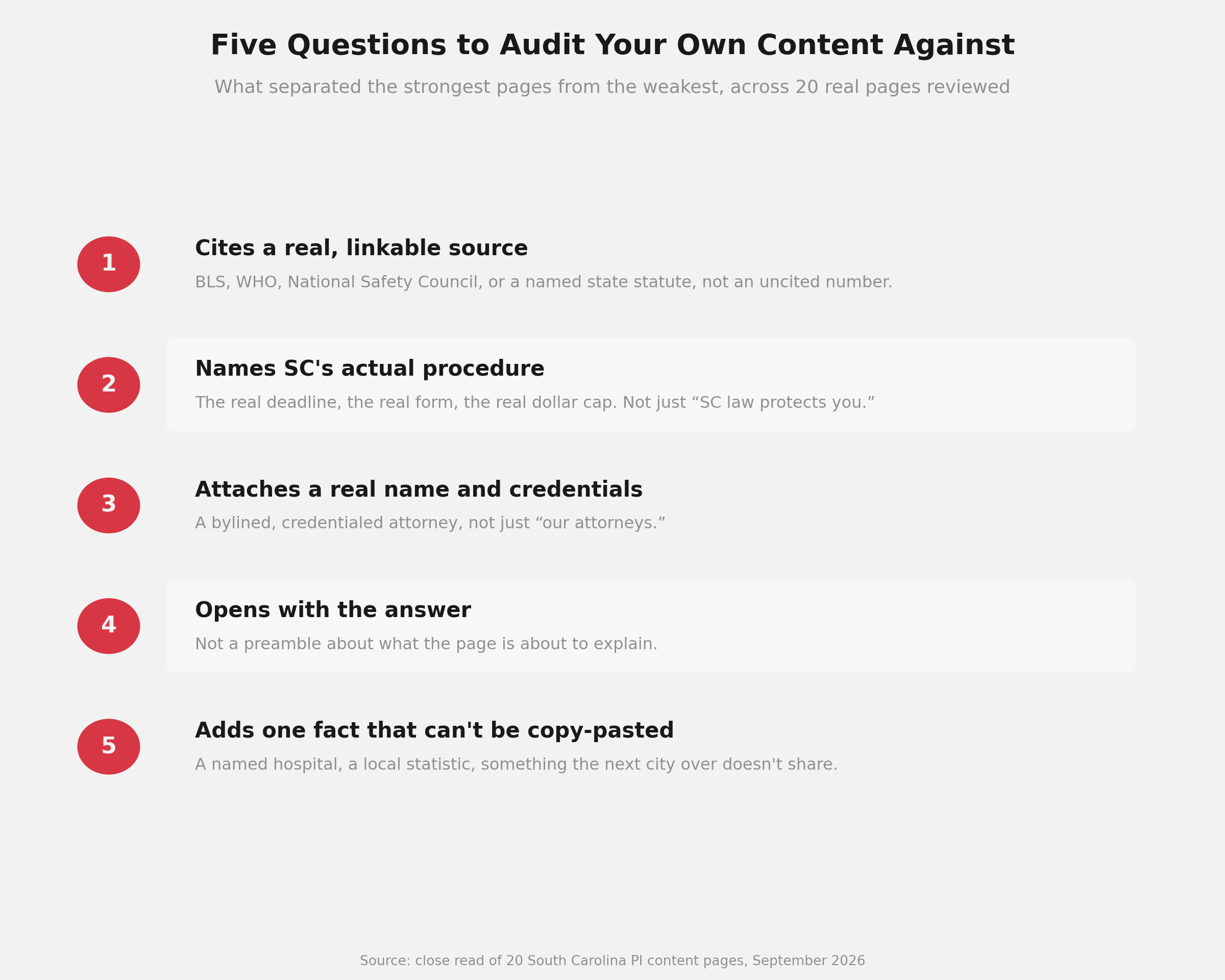
One medical malpractice page we reviewed links directly to the WHO's 2024 global patient safety report, a Harvard Risk Management Foundation study on malpractice claim causes, and the actual South Carolina statute establishing a healthcare provider's duty of care, all inline, all clickable. A workers' compensation page cites the U.S. Bureau of Labor Statistics for injury frequency data and the National Safety Council for average settlement costs, both linked. This is exactly the pattern the research points to: citing recognized sources and linking out for verifiability. Most pages in our sample didn't do this at all. A few asserted specific dollar figures ("average settlements around $400,000") with no source whatsoever, which is a real gap given how easy this is to fix.
They get specific about South Carolina procedure, not just South Carolina law
The pages that stood out didn't just say "South Carolina law allows you to recover damages." They named the actual mechanism: the exact wage-replacement cap in dollars, the ninety-day injury-reporting window, the two-year filing deadline, the specific state form number used to open a claim, the name of the state commission that hears disputes, the pre-suit expert-affidavit and mediation requirement South Carolina imposes on medical malpractice claims before a lawsuit can even be filed. This is precisely the "hard to fake generically" content our last piece described, and on the page level, it's a genuinely sharp differentiator. Pages that stayed at the level of "South Carolina has laws protecting you" read as interchangeable with a page about any other state.
They name a real person, not just the firm
The single clearest E-E-A-T signal in our sample was a page explicitly marked "Legally Reviewed By" with a named attorney, a photo, and a link to a full bio listing specific credentials and named recognitions in that exact practice area, alongside a "Last Updated" date. Other strong pages named the specific attorney handling that practice area directly in the body copy, with years of experience and bar admission stated plainly. The weakest pages spoke only in the collective "our attorneys," with no individual named or credentialed anywhere on the page.
They use structure that's genuinely built for extraction, not just readability. A visible table of contents. Bolded sub-questions functioning as real headers ("What Types of Medical Malpractice Cases Does Your Firm Handle?", "How Safe Are Local Hospitals?"). Numbered claims-process walkthroughs. Bulleted eligibility criteria. One firm's local hospital-safety page went further and embedded actual current safety grades for five specific local hospitals, real, checkable, and not something a generic AI answer could have invented.
What separates a strong blog post from a weak one
The blog and FAQ-style pages showed a different, more subtle pattern.
The strongest ones answer immediately, without a preamble
One informational post about brain injury symptoms opens with a direct "Yes." to an implied question before explaining why, then moves straight into symptom timing. A tax-related post opens with a plain, one-sentence answer to the exact question in the title before any elaboration. Compare that to a post on a similar topic that opens with "This blog post will explore...", a framing device that delays the actual answer and is a weaker execution of the same idea, even though, notably, that particular post still performs well in our data. That's worth sitting with: content structure is not the only thing driving visibility. Domain authority and backlink profile clearly still carry real weight, which means a firm can outrank better-structured competitors on the strength of the rest of its site, at least for now.
The best ones cite a real number from a real source
A page on tinnitus after a car accident cites a specific clinical study statistic on how commonly it accompanies brain injury. A page on shoulder injuries cites the exact Bureau of Labor Statistics injury count and the National Safety Council's average settlement breakdown, split into medical costs versus lost wages. Weaker posts in the same category state similar-sounding numbers with no attribution at all, which is a missed opportunity given how directly the research on this ties statistics and citations to AI selection.
Case outcomes are doing double duty
Several of the strongest blog and practice-area pages weave specific, dollar-figured case results directly into otherwise educational content: a named settlement amount attached to a real injury scenario, sitting inside a page that's ostensibly explaining a legal concept. It's a genuinely effective hybrid: the specificity of a case result functions as a trust signal and a statistic at the same time, even though it's not framed as a citation in the traditional sense.
Two problems worth flagging, since they're easy to miss internally
Two structural issues showed up more than once across different firms, and neither would be obvious to someone just glancing at their own site.
Templated content bleeding across unrelated pages. On more than one site, we found identical FAQ blocks or paragraphs appearing on pages where they had nothing to do with the topic: a drunk-driving FAQ embedded on a medical malpractice page, a Spanish-language paragraph about an unrelated topic embedded mid-article in an English-language blog post. These read as content-management templating errors rather than intentional choices, and they're the kind of thing a busy firm would only catch by actually reading its own published pages side by side, which is exactly what this exercise did.
Boilerplate repeated verbatim across dozens of location pages. Several firms run large city or county-level page networks where the only thing that changes between pages is the place name, with entire paragraphs, sometimes entire pages, otherwise identical. This is a defensible strategy for covering geographic breadth, but it works against the uniqueness and depth signals this whole series has been pointing to. The firms getting more out of their location pages were the ones that added at least one genuinely local detail per page: a named hospital, a specific local statistic, a named local attorney, rather than relying on the city name alone to do the differentiation.
What this means in practice
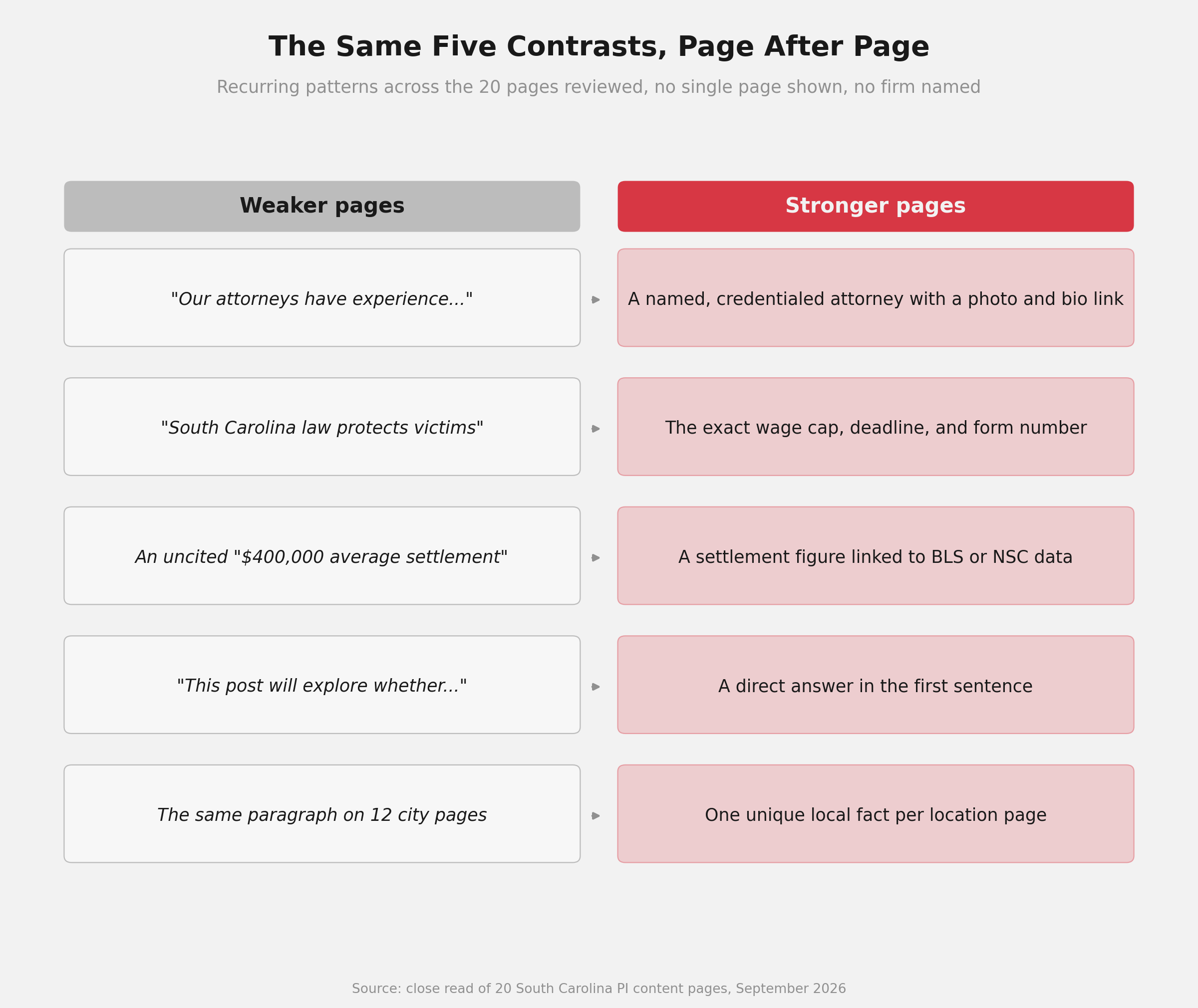
If you're auditing your own site against this, the checklist is short and specific:
None of this requires new content categories or a bigger budget. In nearly every case, the gap between the stronger and weaker pages in our sample was a matter of specificity that was already sitting in an attorney's head or a public database, not a matter of writing more.