


/icon%209.svg)
/icon%2010.svg)
/icon%2011.svg)
/icon%2012.svg)
/icon%2013.svg)
/icon%2014.svg)



Every personal injury firm in South Carolina believes it's competitive online. Most of them are wrong, not because their SEO is bad, but because nobody has ever shown them where they actually stand next to the firms they're really competing against.
So we built that picture ourselves. We pulled organic search data for top personal injury and injury-focused law firms across South Carolina, analyzed how they rank across more than 27,000 personal-injury-related search terms, and looked at what's really happening in the SERPs, including where Google's AI Overviews are (and aren't) getting in the way. This is the first in a series; today's piece covers overall visibility. A follow-up will go deeper into AI Overviews.
How we built this
We pulled organic ranking data for top South Carolina personal injury firms in September 2026 (everything from large, multi-office regional firms to single-attorney practices) and filtered the results down to keywords with genuine personal injury search intent: car and truck accidents, workers' compensation, wrongful death, medical malpractice, nursing home neglect, and similar practice areas. That left just under 65,000 individual keyword rankings across more than 27,000 unique search terms.
A couple of honest caveats before the data. The traffic figures below are organic-only estimates. They don't include the calls and form-fills firms generate from the local map pack, paid ads, or directories. As you'll see below, that's a bigger omission than it sounds like. And "visibility" here means where a firm's own pages rank, not brand awareness or referral volume. This shows organic search performance, not a firm's overall marketing health.
The visibility gap is bigger than most firms think
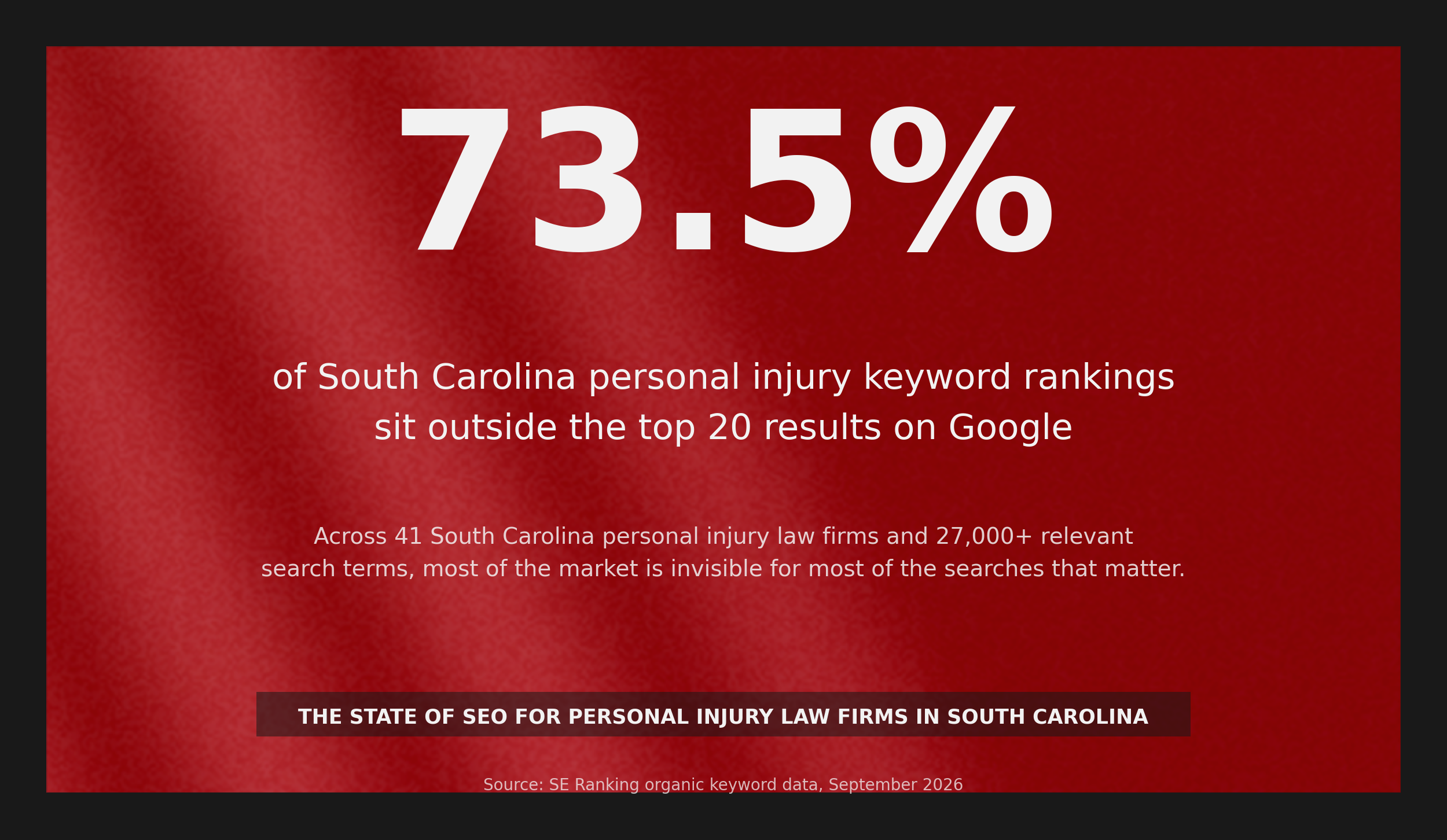
Start with the headline number: 73.5% of all personal-injury keyword rankings we found across these top firms sit outside the top 20 results. Only 7.8% land in the top 3, where most clicks go.
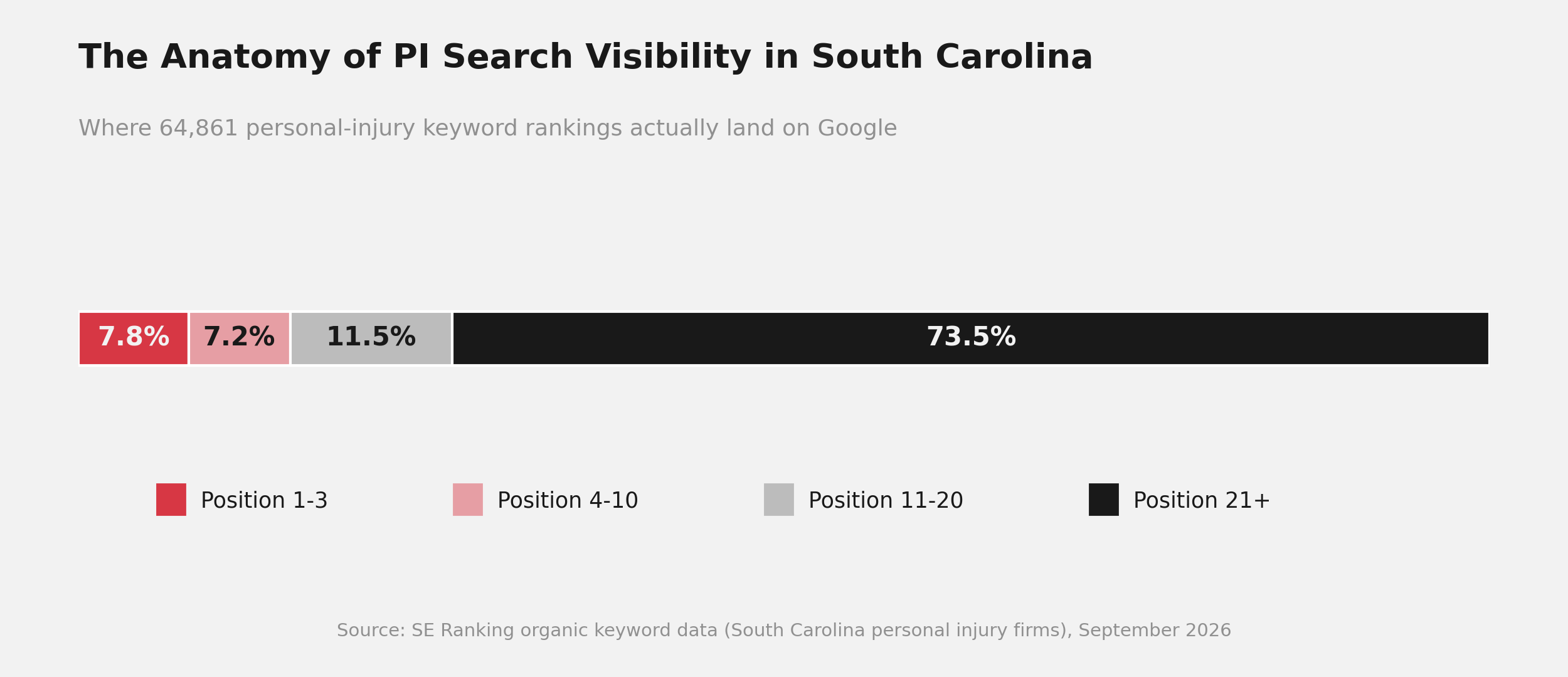
That's not a statement about any one firm's competence. It's a statement about how crowded and long-tail this space actually is. Every firm we looked at ranks for something: a city-specific long-tail phrase, a niche practice area, a branded search. Very few rank consistently on page one for the terms that actually drive new clients. If your firm feels like it's "doing SEO" but not seeing the phone ring, this is probably why. You're likely visible somewhere, just not anywhere that matters.
Visibility in this category is extremely concentrated
Here's a number every firm owner in this space should sit with for a second: a small handful of firms control most of the visibility in South Carolina's personal injury search category.
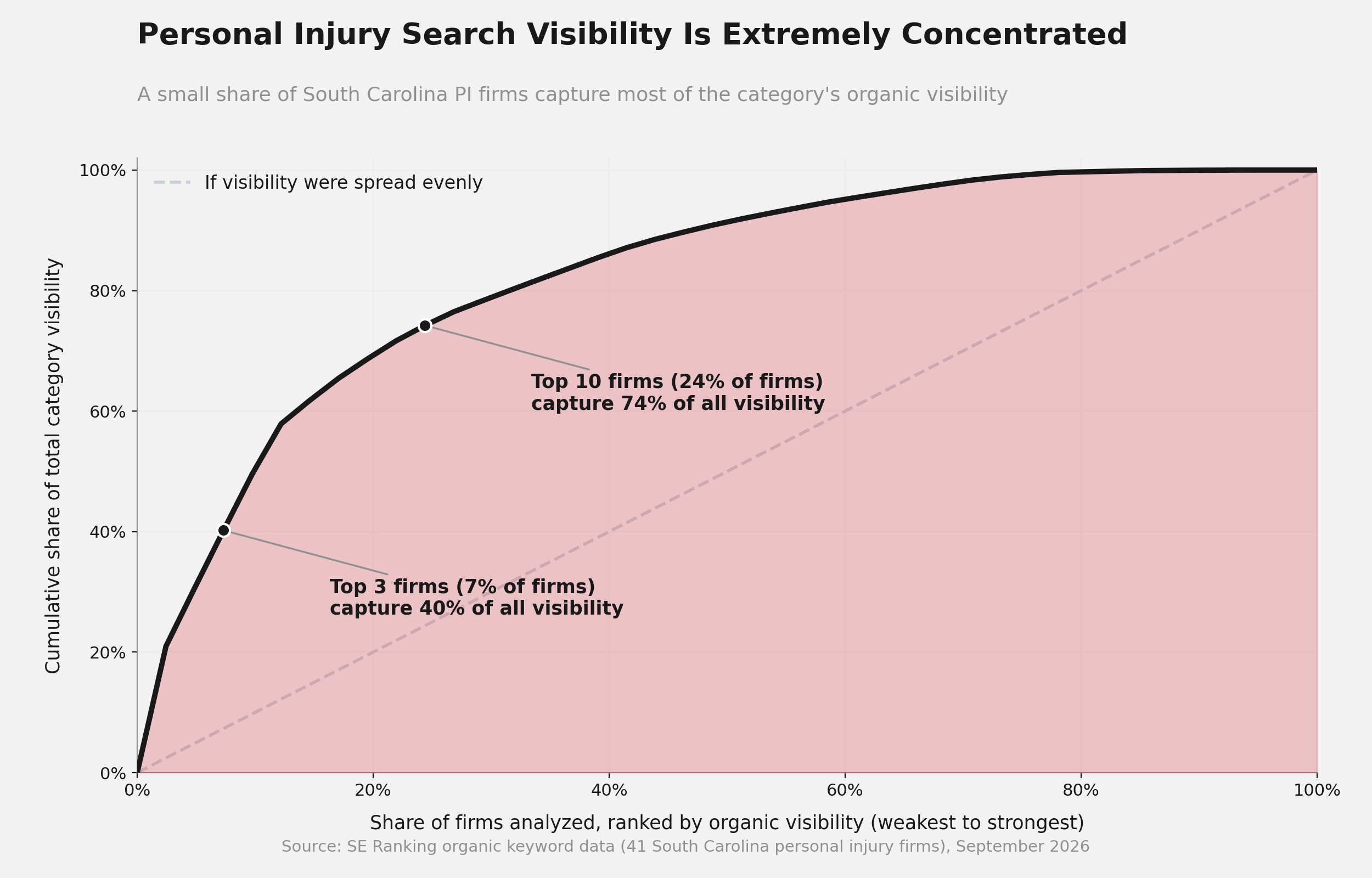
The top 7% of firms we analyzed (roughly three out of every 41) capture 40% of all organic visibility across the entire personal-injury keyword set. Widen that to the top quarter of firms, and they control nearly three-quarters of all visibility. The bottom half of the market, by contrast, splits barely 8% of it between them. This is not a market where everyone is bunched together fighting over roughly equal scraps. It's a steep power-law curve, and most firms sit well down on the wrong side of it.
Two things are worth taking from this. First, if your firm isn't in that leading group, you're not competing against "the market" in any diffuse sense. You're competing against a small, identifiable set of firms that have built a real, compounding lead, and closing that gap takes sustained investment, not a few new blog posts. Second, organic visibility is only one input into client acquisition, not the whole picture. A firm outside the leading group with a dominant Google Business Profile and strong map-pack presence in one metro can still out-convert a firm with a bigger organic footprint. That's exactly what the next section is about.
AI Overviews own the research phase, not the hiring moment
This is the finding we think matters most right now, and it's more nuanced than the "AI is eating everyone's traffic" narrative you've probably heard.
We split personal-injury keywords into two groups: "money" searches (local, commercial intent: someone actively looking to hire an attorney) and informational searches (someone researching what to do after an accident, how a claim works, what their case might be worth). Then we checked how often each type of search triggers an AI Overview versus a local map pack.
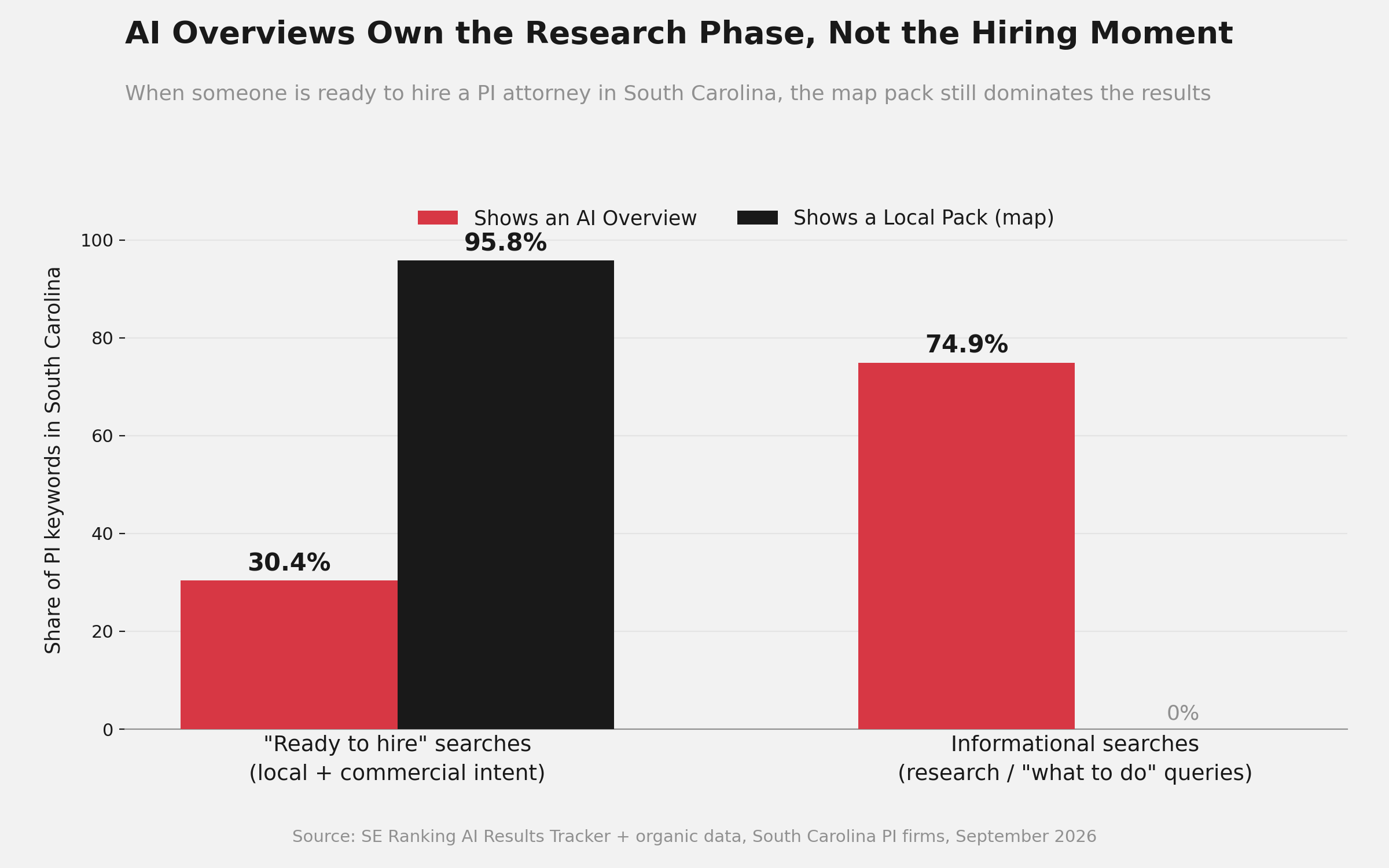
The split is stark. On searches where someone is ready to hire, like "personal injury lawyer near me," "truck accident attorney Columbia SC," or "workers comp lawyer," a local map pack appears 95.8% of the time, while an AI Overview shows up on just 30.4% of those same searches. Flip to informational queries, and it reverses almost completely: AI Overviews appear on 74.9% of them, and local packs essentially never show up.
Put plainly: Google is still routing "I need to hire someone" to the map pack, not to an AI-generated answer. This tracks with what's been reported industry-wide (legal search overall triggers AI Overviews around 78% of the time, the highest of any industry), but our data shows that headline number is being driven almost entirely by informational, top-of-funnel searches. The moment someone is actually shopping for representation, the SERP still looks a lot like it did two years ago: three map pack listings, reviews, and a "more places" link.
There's a second layer to this worth calling out. Take the highest-volume "money" keywords in our dataset: "personal injury lawyer near me" (301,000 monthly searches) and "personal injury attorney" (110,000). Neither has a single South Carolina firm ranking organically in the top 20. That's not really a content gap. It's a sign that for these ultra-broad, high-volume terms, the organic result you'd normally chase barely matters. The battle has already moved to the map pack and paid ads, and no amount of blog content will outrank that reality.
What this means practically: treat these as two separate battles, because they are. Your Google Business Profile, review volume, NAP (name, address, and phone number) consistency, and local citations are what win the hiring moment. That infrastructure deserves at least as much attention as your website. Separately, your blog and educational content is what gets you cited inside AI Overviews for research-stage searches, which builds the brand awareness that eventually turns into a branded search or a referral. Both matter. They're just not the same fight, and firms that pour all their budget into blog content while neglecting their Google Business Profile are optimizing for the wrong 30%.
Practice-area pages do the heavy lifting, not blog posts
A lot of firms assume that publishing blog content is the primary lever for organic growth. Our data says otherwise.
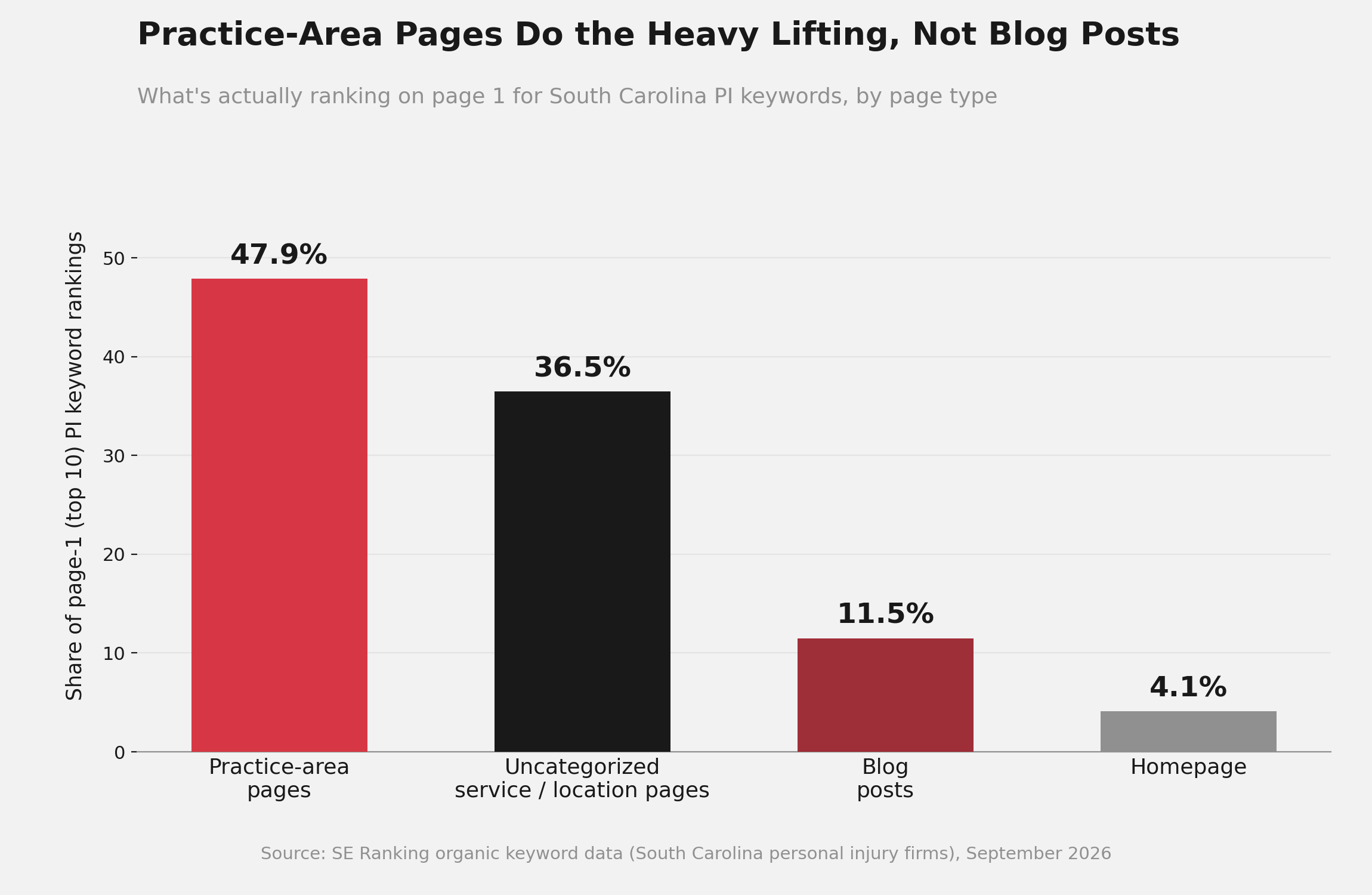
Nearly 48% of all page-one rankings in our dataset come from dedicated practice-area pages: car accident pages, truck accident pages, city-specific landing pages, and similar service content. Blog posts account for just 11.5% of page-one rankings, even though most firms spend the bulk of their content budget there.
This doesn't mean blogging is a waste of time. Informational content is exactly what AI Overviews are picking up, as the previous section showed. But if the goal is ranking for the commercial terms that actually produce cases, a firm is generally better served by building out deep, well-structured practice-area and location pages (car accidents in Charleston, truck accidents in Columbia, slip and fall in Greenville) than by publishing another general-interest blog post. Most firms have this backward: a handful of thin practice-area pages and a large, sprawling blog. The data suggests flipping that investment.
The local battlefield: where South Carolina actually searches
Personal injury is a hyper-local business, and demand isn't evenly spread across the state.
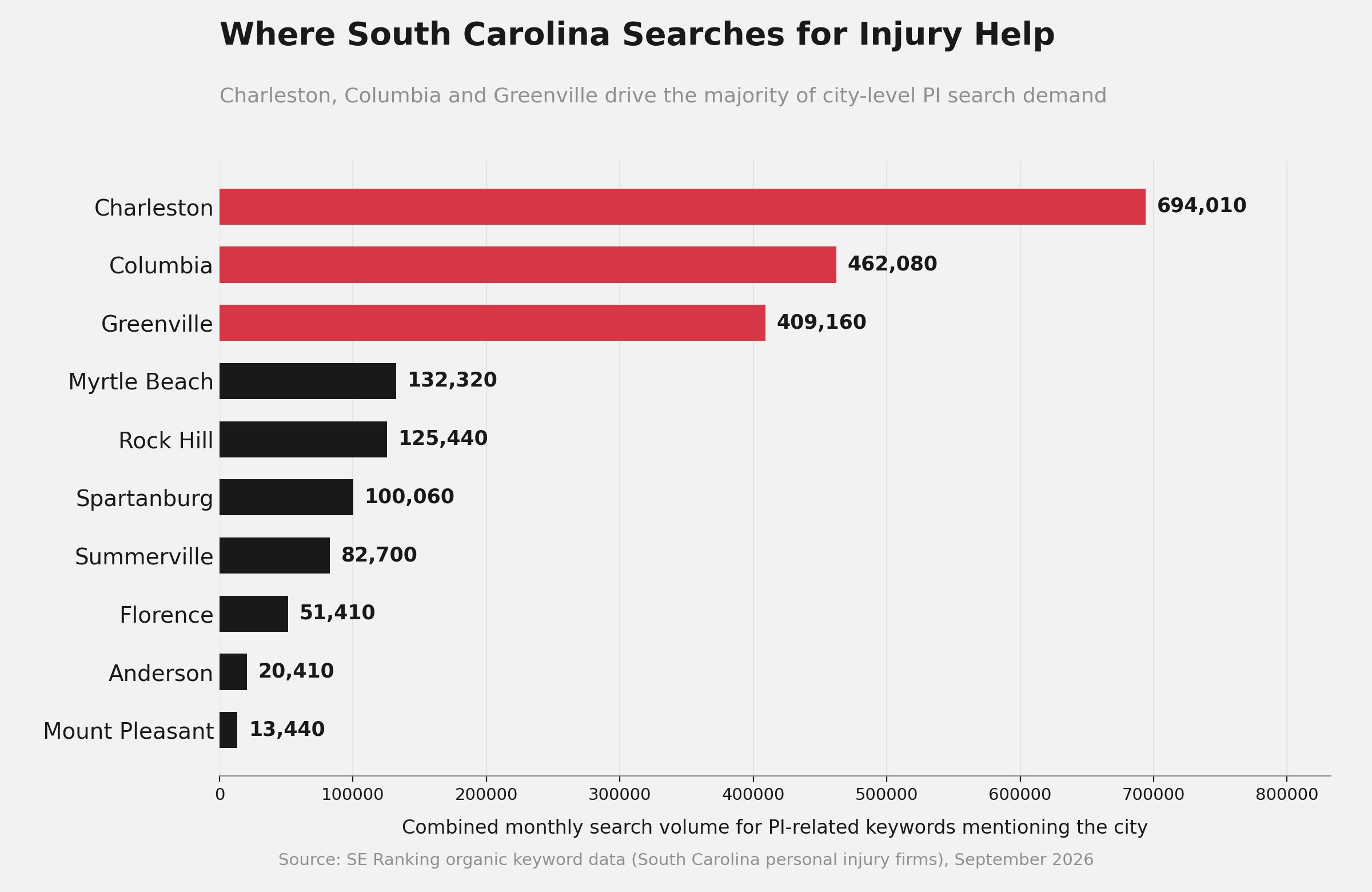
Charleston, Columbia, and Greenville combine for the large majority of city-specific search demand in our dataset, with Charleston alone generating nearly 694,000 in combined monthly search volume across PI-related, city-qualified keywords. That also means these three metros are where competition is fiercest. A disproportionate share of the top firms we analyzed are fighting over the same Charleston and Columbia terms.
The opportunity sits at the edges. Cities like Anderson, Aiken, Sumter, and Mount Pleasant show real, sustained search demand with a fraction of the competitive intensity of the big three. For a firm without the budget to out-content the market leaders in Charleston, building genuinely strong, locally specific pages for a secondary market is a far more winnable fight.
What this means for your firm
A few takeaways worth acting on, regardless of where your firm currently sits in this category:
- Don't confuse blog output with ranking power. Practice-area and location pages are what's actually winning page one. If your content calendar is 90% blog posts, that's likely misallocated effort.
- Your Google Business Profile is not optional infrastructure. For the searches that actually produce cases, the local pack (not the organic results) is where the decision happens 96% of the time.
- AI Overviews are a research-phase problem, not a hiring-phase problem (yet). Don't panic-restructure your whole site around getting cited in AI answers at the expense of the local SEO fundamentals that still win the moment someone picks up the phone.
- Look past Charleston, Columbia, and Greenville. The biggest cities have the most demand and the most competition. Secondary markets offer a real, winnable path to visibility.
- Target realistic, specific opportunities. The generic "personal injury lawyer near me" fight isn't an organic content problem. The 1,100+ moderate-volume, poorly served keywords we identified are.
We'll be following this up with a closer look at AI Overviews specifically: what separates the pages that get cited inside them from the pages that don't, and what that means for how you structure your content. If you want to see exactly where your firm sits against this data, that's a conversation worth having.