


/icon%209.svg)
/icon%2010.svg)
/icon%2011.svg)
/icon%2012.svg)
/icon%2013.svg)
/icon%2014.svg)



The Truth Most Personal Injury Lawyers Don’t Want to Admit
You are not losing cases to better lawyers.
You are losing them to better-reviewed lawyers.
When someone searches for a personal injury attorney today, they do not start by evaluating courtroom skill or years of experience. They start with Google reviews. They compare star ratings. They scan comments. They look for reassurance that your firm will call them back, fight for them, and deliver a result.
Then they choose who to call.
If your competitor has 350 reviews and you have 42, you are already behind before intake even answers the phone. If their reviews are more detailed, more recent, and more emotionally compelling, they will win a significant share of the best cases in your market.
Reviews are no longer a reputation accessory. They are a primary driver of case acquisition.
This guide is not about getting a few extra five-star ratings.
This is about building a review engine that directly increases signed cases and revenue.
Why Reviews Are Now a Core Revenue Channel for PI Firms
Personal injury is a trust-driven business. Every case starts with fear and uncertainty. The client is asking one question:
“Can I trust this firm with my case?”
Reviews answer that question faster than anything on your website.
Reviews Pre-Sell Your Firm Before Intake Ever Speaks
By the time a prospect calls, they have already read your reviews.
They already have an opinion.
Strong review profile:
- Intake conversation starts with trust
- Less price sensitivity
- Higher sign rate
- Better cooperation from client
Weak review profile:
- Skepticism
- More shopping behavior
- Lower conversion
- More intake friction
Reviews shape the conversation before it begins.
Reviews Directly Impact Local SEO Visibility
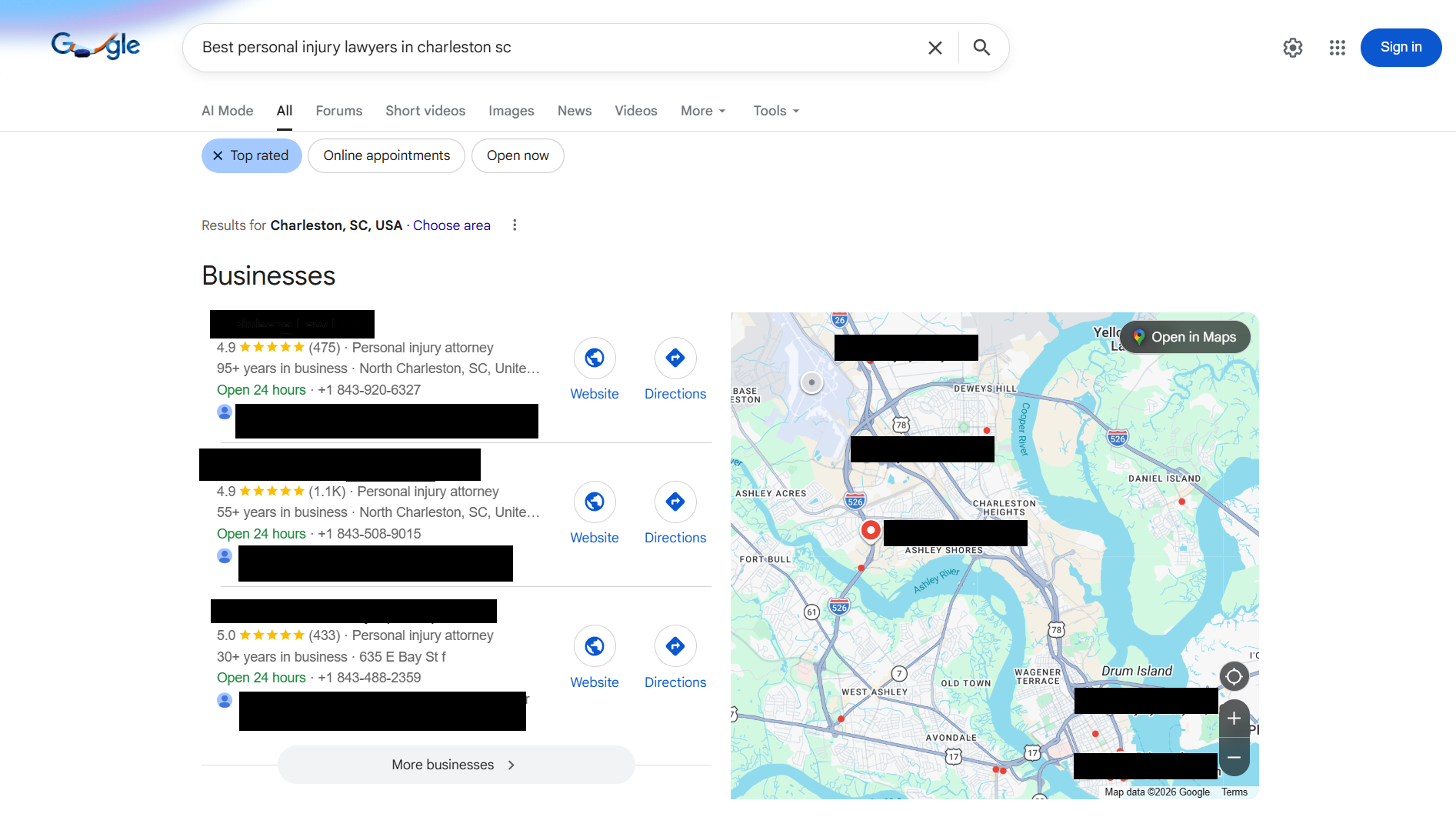
Google heavily weights review signals when ranking personal injury firms locally.
Key factors include:
- Total number of reviews
- Frequency of new reviews
- Star rating
- Keywords inside reviews
- Responses from the firm
If two firms have similar websites and SEO strength, the firm with the stronger review profile almost always ranks higher in the map pack.
Reviews are not just reputation. They are a ranking signal. They are a core component of serious SEO for personal injury lawyers.
Reviews and Local Service Ads: Where Real Money Is Won or Lost
Most personal injury lawyers spend aggressively on Local Service Ads but underestimate how much reviews influence performance.
This is a major mistake.
Reviews Influence LSA Positioning
When multiple firms compete in the same market, Google favors firms with stronger trust signals. Review volume and rating are major trust indicators.
A firm with:
- Higher rating
- More reviews
- Consistent recent reviews
often appears more prominently and receives more engagement.
Reviews Drive Click and Call Behavior
Before clicking your LSA profile, prospects compare:
- Your star rating
- Number of reviews
- Competitors next to you
If your profile shows 4.9 stars with 250 reviews and the competitor shows 4.5 with 60, you win the click more often.
That directly affects:
- Call volume
- Cost per lead
- Cost per signed case
Reviews Improve Conversion From LSA Leads
Better review profiles create immediate trust when prospects click your profile or call. That trust increases signed case rates and improves ROI on ad spend.
If you are spending heavily on LSAs without a structured review strategy, you are leaving serious money on the table.
What the Top PI Firms Do Differently
The highest-growth personal injury firms treat reviews like a production system, not a marketing afterthought.
They track reviews the same way they track:
- Leads
- Signed cases
- Cost per acquisition
- Settlement volume
They know exactly how many reviews they generate per month and per closed case.
Most importantly, they do not “hope” for reviews. They operationalize them.
The Three-Part Framework: Volume, Quality, Compliance
A dominant review presence requires balance.
Too many firms focus on only one piece.
1. Volume: You Need Market-Level Authority
If you want to dominate locally, your review count must reflect market leadership.
When a prospect sees hundreds of reviews, they assume:
- This firm handles a lot of cases
- This firm is established
- This firm gets results
- Many people trust this firm
That perception alone increases calls.
A firm with 300+ strong reviews holds a psychological advantage before the first conversation.
2. Quality: Details Convert Cases
Short reviews help rating averages.
Detailed reviews help sign cases.
The most powerful reviews mention:
- Case type
- Attorney or staff name
- Communication experience
- Outcome or satisfaction
- Emotional relief
These create connection and reassurance for prospective clients.
They also naturally strengthen keyword relevance for search when clients mention phrases like:
- car accident
- truck accident
- injury claim
- settlement
- insurance company
3. Compliance: Protect Your License and Reputation
Every review strategy must stay within ethical guidelines.
Never:
- Offer incentives
- Write reviews for clients
- Post fake reviews
- Pressure unhappy clients
One compliance issue can do more damage than hundreds of positive reviews can fix.
The Right Way to Generate Reviews Consistently
Most firms ask randomly or only when they remember. That approach produces weak results.
Review generation should be built into your case workflow.
The Best Time to Ask
Timing matters more than wording.
Ask when the client feels:
- Relief
- Gratitude
- Closure
- Appreciation
Strong moments include:
- After settlement
- After check delivery
- After successful resolution
- When client expresses thanks
Never ask during stressful litigation phases.
Assign Ownership Inside the Firm
If review generation is not assigned, it does not happen.
Someone must own it.
Typically:
- Case manager
- Client relations
- Intake manager
- Marketing coordinator
Every closed case should trigger a review request automatically.
Create a Simple Repeatable System
Your system should include:
- Thank-you message
- Direct review request
- Google review link
- One follow-up reminder
Simple systems outperform complicated ones every time.
How Reviews Strengthen Your Entire Marketing System
Reviews should support every marketing channel.
They improve:
- Local SEO rankings
- Google Maps visibility
- LSA performance
- Website conversion rates
- Referral confidence
They also make every other marketing dollar work harder.
A firm with strong reviews converts more traffic from the same SEO or ad spend than a firm with weak reviews.
This is why reviews must be integrated into your broader Personal Injury Lawyer Marketing strategy, not treated as a side task.
Responding to Reviews the Right Way
Every response is public-facing brand positioning.
Respond to All Reviews
It signals professionalism and activity.
Positive Reviews
-
Keep it short.
-
Show appreciation.
-
Stay professional.
Negative Reviews
-
Stay calm.
-
Never argue.
-
Invite offline resolution.
Prospective clients judge you by how you respond to criticism.
If You Build This Right, It Compounds for Years
Reviews compound like interest.
A firm that builds aggressively for 24 months can create a nearly uncatchable reputation advantage in its market. That advantage leads to:
- More calls
- Better cases
- Higher trust
- Easier intake
- Stronger referrals
- Lower cost per signed case
Firms that ignore reviews stay stuck competing on price, ads, and constant marketing spend.
Firms that build review dominance become the obvious choice in their market.
The Bottom Line
When two personal injury firms appear side by side online, the one with the stronger reviews usually gets the call.
-
Not the smarter lawyer.
-
Not the older firm.
-
Not the nicer office.
The firm with the stronger reputation.
Reviews for personal injury lawyers are now one of the most powerful drivers of case growth. Firms that build a structured, ethical, and consistent review engine will dominate their local markets.
Those who ignore it will continue losing cases quietly to competitors who understand how modern clients choose lawyers.
Want a Review Strategy That Actually Drives Cases?
Most marketing agencies treat reviews like a small reputation task.
Serious PI firms know better.
At VIP Marketing, we build complete growth systems for personal injury firms that want more signed cases, stronger visibility, and real market dominance. From review generation and reputation strategy to SEO, web design, LSAs, and paid advertising, every piece is engineered for one outcome: case growth.
If you want a marketing partner that understands how personal injury firms actually grow and compete, it is time to talk.
Contact VIP Marketing, the law firm marketing agency you need today and build a reputation that brings high-value cases to your firm every single month.