


/icon%209.svg)
/icon%2010.svg)
/icon%2011.svg)
/icon%2012.svg)
/icon%2013.svg)
/icon%2014.svg)


For a DUI defense attorney, business growth is not a slow burn. It is a series of immediate, high-stakes sprints. Unlike corporate law or estate planning, where clients take weeks to research and select representation, a DUI prospect usually makes a hiring decision wthin a 24 to 72-hour window. They are searching on mobile devices, often late at night or over the weekend, under extreme emotional and legal stress. If your digital marketing framework is treated as a generic, set-and-forget campaign, you are leaking valuable leads to your competitors. To dominate your local market, you need a highly responsive, multi-channel client acquisition engine. This guide breaks down the technical, strategic, and regulatory realities of DUI marketing to help you secure more signed cases and maximize your return on investment.
1. The Local SEO Engine: Dominating the Map Pack
Because DUI defense is localized, your digital footprint must be highly visible to users within your specific jurisdiction. When prospective clients search for help, Google's Local Map Pack appears at the top of the search results. Securing a spot in this three-firm local pack can generate 15 to 40 additional leads every month. To build a high-ranking local search engine, prioritize the following actions:
- Claim and Optimize Your Google Business Profile: Set your primary business category to "DUI lawyer" rather than a generic legal classification to send highly specific signals to search crawlers. Make sure your operational hours are set to 24/7, as arrests do not respect standard business hours.
- Deploy LegalService Schema Markup: Add behind-the-scenes structured metadata to your website. This code explicitly defines your firm's coordinate location, operating hours, and specific defense practice areas to search engine spiders.
- Build City-Specific Landing Pages: Do not rely on a single, broad defense page. Build unique, robust landing pages of at least 800 words for each city or county where you practice. Include local courthouse locations, regional DMV rules, and specific municipal DUI processes to show genuine local expertise.
- Establish Consistent NAP Data: Your Name, Address, and Phone number must be identical across major legal directories, including Avvo, Justia, FindLaw, and SuperLawyers. Consistent directories build the digital trust Google needs to rank you in the Map Pack.
2. Paid Search: Balancing Google LSAs and Traditional PPC
Organic SEO builds compounding, long-term equity, but paid search is the fastest way to get immediate results. To run a profitable paid campaign, you must combine Local Services Ads (LSAs) with highly targeted Pay-Per-Click (PPC) campaigns.
Google LSAs versus Traditional PPC
| Operational Parameter | Google Local Services Ads (LSAs) | Traditional Google PPC Search Campaigns |
| Billing Mechanism | Pay-per-lead (direct phone calls or text inquiries) | Pay-per-click (visitors routed to a website or landing page) |
| Average Cost Benchmarks | $120 to $280 per qualified lead | $50 to $200 per click in competitive metros |
| Cost Per Signed Case | $200 to $500 per signed retainer | $300 to $800 per signed retainer |
| Creative Control | Minimal (Google auto-generates the profile template) | High (custom headlines, ad copy, and extensions) |
| Primary Failure Point | Unanswered calls or failing to dispute invalid leads | Broad match bidding and sending traffic to a generic homepage |
Managing the Privilege Risks of Google LSAs
The 2025 and 2026 Local Services Ads terms of service present a major compliance risk for defense lawyers. Google reserves the right to record, transcribe, and review the contents of all calls routed through the LSA platform to evaluate lead quality and optimize its systems. Because an unassociated third party is recording these calls, you risk waiving attorney-client privilege before representation even begins. To protect your prospective clients and your practice, establish a strict, dual-stage intake protocol:
- Stage One (The LSA Call): Instruct your intake team to collect only basic contact information and generic eligibility details during the initial LSA-routed call. They should explicitly state that this call does not establish a formal attorney-client relationship.
- Stage Two (The Secure Callback): Once basic contact details are logged, immediately call the prospect back using your firm’s secure, private, unrecorded phone lines to conduct the substantive case interview.
3. Google's New Maps Rating Manipulation Policy
Google's review guidelines, heavily enforced by Gemini-powered AI moderation systems, have changed how law firms must approach online reputation management. Practices that were standard in previous years are now categorized as rating manipulation and can lead to immediate suspension of your Google Business Profile. To remain compliant, you must strictly avoid the following banned practices:
- No On-Premises Solicitation: Encouraging clients to write reviews while they are still in your office is strictly prohibited. Google's AI monitors shared local IP networks and device fingerprints. If multiple reviews are submitted from the same office IP address, they will be flagged and deleted.
- No Review Gating: You cannot pre-screen clients with a survey and only send Google review links to those who report a positive experience. Review requests must be sent to all clients equally.
- No Staff Review Quotas: You may not incentivize your staff with bonuses, performance metrics, or contests based on the volume of reviews they secure. Google views structured staff incentives as a form of biased, manipulative solicitation.
- No Scripted Content: Asking clients to include highly specific keyword phrases in their reviews, such as naming a specific attorney or using the term "best DUI lawyer," is banned.
The Compliant Solution
Transition to an automated, post-service outreach system via your legal CRM. After a case is successfully closed and the client has left your office, send a neutral, automated SMS or email requesting feedback. This allows the client to write the review from their own device, on their own network, in a natural manner.
4. Generative Engine Optimization: Preparing for the AI Era
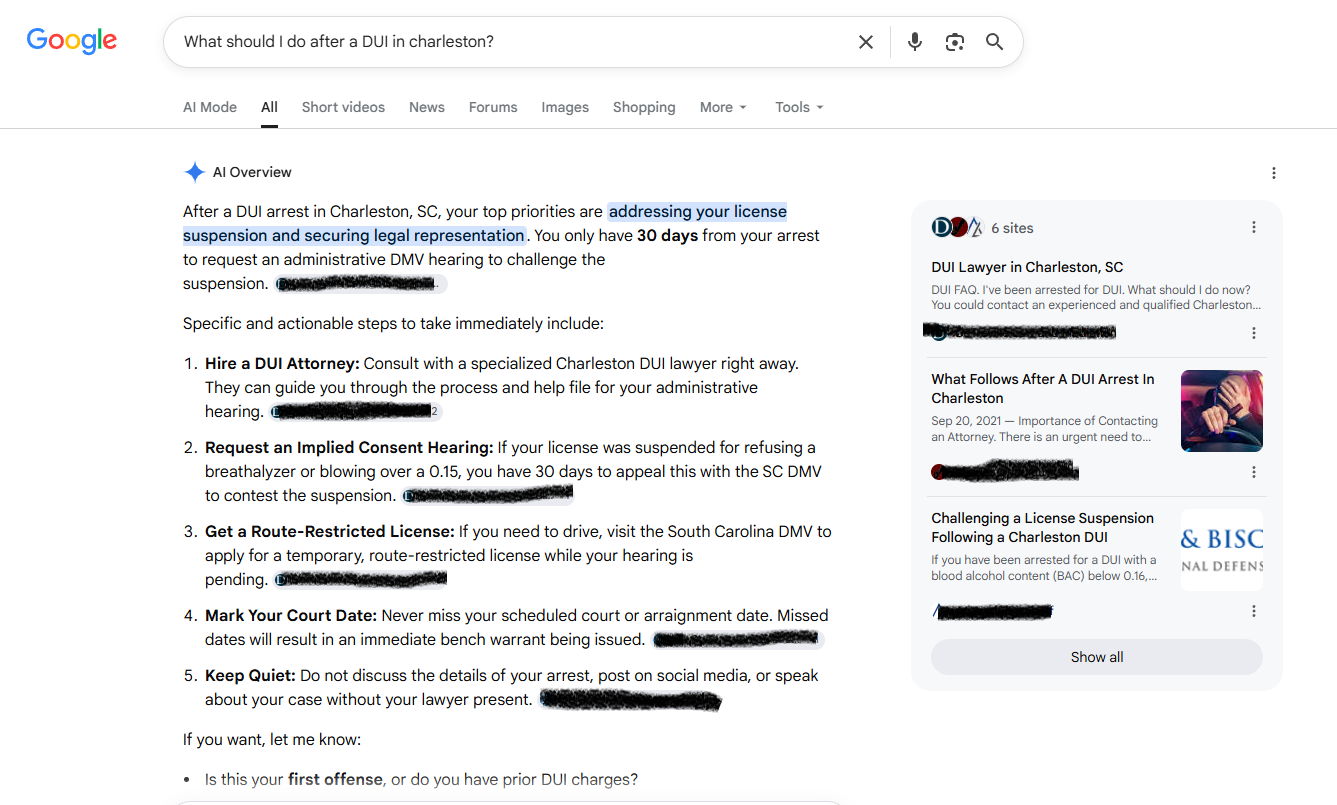
Search is shifting from a list of blue links to AI-synthesized responses. Prospective clients are now using conversational search engines, including Google's AI Overviews, Perplexity, ChatGPT, and Gemini, to find legal assistance and evaluate firms. To ensure these platforms cite and recommend your firm, you must optimize your site for Generative Engine Optimization (GEO).Implement these technical and structural content standards to adapt your site for Retrieval-Augmented Generation (RAG) models:
- Provide Direct, Immediate Answers: Write a concise, 60-word summary answering the core legal question directly beneath your heading. AI engines scan for these clear, direct answers to pull into their informational snippets.
- Format with Conversational Headings: Structure your pages using clear, question-based H2 and H3 headings. Frame them exactly as a user would speak into a voice-activated device, such as: "Will I lose my commercial driver's license after a first-offense DUI in California?"
- Cite Primary Legal Authorities: Do not rely on vague summaries. Back up every legal description on your site with citations to specific state statutes, courthouse locations, or appellate rulings, and link to primary source materials where possible.
- Maintain a Detailed Semantic Schema: Use comprehensive schema markup to ensure AI engines can clearly identify your bar admissions, certifications, and official office locations.
5. Designing Your Intake System as a Conversion Engine
High-quality marketing will only get prospects to reach out. Your intake department must convert those inquiries into signed clients. In DUI defense, speed is the single most important factor in your conversion rate. If you do not answer a call or reply to an online form within five minutes, the prospect will call another firm.
The overall effectiveness of your intake process can be measured using this core formula:
End-to-End Conversion Rate= {Visitor-to-Lead} x {Lead-to-Consultation} x {Consultation-to-Signed}
To understand where your practice stands, compare your current metrics against these industry benchmarks:
| Conversion Funnel Stage | Industry Average Benchmark | Top-Performing Firm Benchmark | Primary Failure Mechanism |
| Response Speed | 8+ hours for web leads; 1+ hours for phone calls | Under 5 minutes (via automated calls or texts) | The lead calls a competitor after a five-minute delay |
| Visitor-to-Lead Rate | 2.2% of website traffic | 5% to 7% of website traffic | Poor mobile layout and slow page load speeds |
| Lead-to-Consultation | 60% to 80% | 80%+ | Lack of structured, automated follow-up protocols |
| Consultation-to-Signed | 30% to 50% | 50%+ | Inadequate lead qualification or pricing objections |
| Overall Conversion Rate | 14% of total inquiries | 40% to 50% of total inquiries | Cumulative leaks across every step of the intake funnel |
Plugging the Leaks in Your Intake Funnel
To reach these top-performing benchmarks, integrate your digital advertising directly with a specialized legal CRM such as Clio Grow. Because roughly 64% of legal inquiries occur outside of standard business hours, you should employ a 24/7 virtual receptionist service or an automated web-chat feature. Setting up an automated SMS reply to fire within 60 seconds of a missed call or web inquiry can recover 20% to 40% of leads who would otherwise keep calling other firms.
6. Budgeting and High-Value Community PR
A healthy marketing budget for a growing DUI defense firm typically ranges from 8% to 15% of your gross revenue. For a practice earning $500,000 annually, this equates to a marketing investment of $40,000 to $75,000 per year. To get the best return, allocate your budget across these core areas:
- Paid Search (35% to 45%): For immediate, direct client acquisition through LSAs and targeted PPC.
- Organic SEO and Content (30% to 40%): To build long-term local search authority and rank for valuable local keywords.
- Local Public Relations (5% to 10%): For community outreach, local sponsorships, and high-quality backlink generation.
The Holiday Sober Ride Program
One of the most effective ways to build both local brand awareness and organic authority is to run a holiday sober ride program. Under this program, your firm offers to reimburse taxi or rideshare fares for community members during high-risk holidays, such as New Year's Eve, St. Patrick's Day, or the Fourth of July. An investment of $1,500 to $5,000 in rideshare reimbursements can yield a significant return. The program often attracts coverage from local news outlets, chamber of commerce sites, and municipal blogs. This media coverage generates highly authoritative, geographically relevant backlinks that are incredibly difficult for your competitors to replicate, giving your local search engine optimization a significant boost.
A Strategic Approach to Firm Growth
Growing your DUI defense practice requires a metrics-driven approach. Rather than focusing on vanity metrics like impressions or clicks, evaluate your marketing partners based on your Cost Per Signed Case. By combining localized SEO, compliant review acquisition, and rapid intake systems, you can build a highly resilient marketing engine that keeps your firm busy all year round.