


/icon%209.svg)
/icon%2010.svg)
/icon%2011.svg)
/icon%2012.svg)
/icon%2013.svg)
/icon%2014.svg)



If you own a criminal defense firm, you do not need another list of SEO tasks. You need to know where prospective clients are looking, what they expect to see, and which marketing work deserves your attention first.
Today, a prospective client may find your firm in Google Maps, traditional search results, or an AI-generated answer. Those searches often happen at very different points in the case, from the first call after an arrest to questions about bail, arraignment, sentencing, or clearing a record.
What law firm owners should know first?
- Lawyer-seeking searches cost about four times more than educational ones. The median top-of-page bid is $37.07 for lawyer-seeking keyword groups and $8.54 for informational groups.
- DUI has the highest median paid-search bid in the charge data. Its median bid is $84.20, and the top tenth of DUI groups bid $179.57 or more.
- Demand is concentrated in a few head terms. 61% of the relevant keywords get 50 searches a month or fewer, and only 92 get 10,000 or more.
- AI Overviews and the map pack split the results page. Among keywords the eight sites rank for, an AI Overview appears on 69% of informational results and 36% of lawyer-seeking results. The local pack appears on 80% of lawyer-seeking results and 5% of informational ones.
- One Los Angeles boutique earns about 31,400 estimated monthly visits, 96% from informational queries. Only 3.9% of those visits come from commercial or transactional queries.
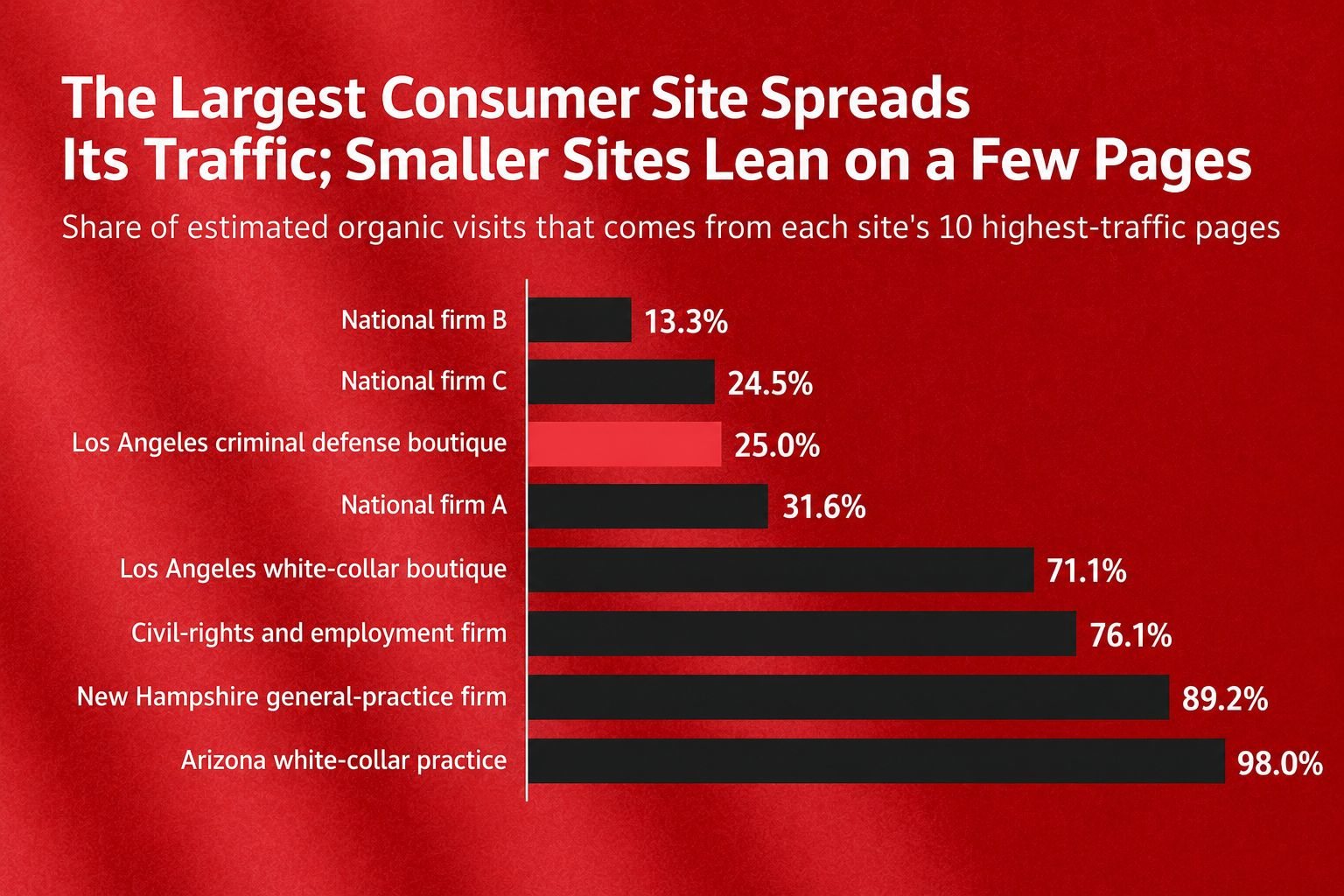
- A broader content base can reduce traffic concentration. That firm's top 10 pages hold 25% of its estimated traffic. For the four smaller firms in the set, the top 10 pages hold 71% to 98%.
- On one high-traffic site, stronger organic rankings were associated with higher AI Overview citation rates. On that site, pages ranking in the top 10 were cited in the AI Overview about 23% to 24% of the time. Pages ranking below 20 were cited 7.6% of the time.
- Family members are invisible in the keyword data. Keyword Planner returned six keywords that name a spouse or partner, each at 10 searches a month. You will need your own call and Search Console data to size that group.
Choose the path that fits your firm
|
If you are... |
Start here |
Your first goal |
|
Launching a new or solo firm |
Appear in the map pack and rank for 3 to 5 charge pages |
|
|
Spending on SEO, ads, or AI but not getting the leads you want |
Find whether the gap is visibility, clicks, calls, or lead quality |
|
|
Established and ready to dominate your market |
Build breadth of content and local proof together |
|
|
Running multiple offices |
A location structure that scales without thin pages |
|
|
Handling federal or white-collar defense |
Authority over proximity |
1. Start with how your clients search
Before deciding what to publish or where to spend money, understand what a potential client is trying to do at each stage of a criminal case. The search itself tells you what the person needs from your firm.
Searching follows the life of a case, and the window to win the call is shortest at the start. Someone who has just been arrested types "criminal defense attorney near me." Weeks later, the same person types "what happens at arraignment." Months later they may search "expungement lawyer." Each stage tends to lead to a different kind of search result.
Who is searching
The person typing is often not the person charged. Plan for five searchers:
-
The arrested person, usually on a phone and often at night.
-
A family member or partner, who searches on someone else's behalf. They ask about jail, bail, and how to hire a lawyer for another person.
-
Someone under investigation, before any arrest. They are research-minded and wary of calling.
-
Someone clearing a record, who is not in a hurry and compares prices.
-
A business owner or professional in a white-collar matter, who values the attorney's specific experience over proximity.
The family-member group is barely visible in the keyword data. Keyword Planner returned only six keywords that name a spouse or partner, such as "my boyfriend got arrested what do i do," each at 10 searches a month. That does not mean the group is small. It means the tool is blind to it, so check your own call notes and Search Console queries.
The Arrest-to-Appeal Search Map
Volumes are Google's rounded monthly averages for the keyword group. The bid is the high end of Google's top-of-page range.
|
Stage |
What people type (volume group, high bid) |
Where this search appears in the sample |
|
Arrest or warrant |
criminal defense attorney near me (90,500, $66.15); dui attorney near me (60,500, $94.07); bench warrant attorney (6,600, $19.83) |
Map pack, ads |
|
Bail |
how do bonds bail work (9,900, $3.66); how does bail work (5,400, $2.00) |
AI answers, organic explainers |
|
Arraignment and early hearings |
arraignment (49,500, $0.48); preliminary hearing (14,800, $0.03); grand jury indictment (4,400, $1.11) |
AI answers, organic explainers |
|
Choosing a lawyer |
best criminal lawyer near me (4,400, $50.82); criminal defense attorney cost (3,600, $19.48); free consultation criminal lawyer (2,400, $22.18) |
Map pack, reviews, fee pages |
|
Plea or trial |
plea bargain (18,100, $7.03) |
AI answers, organic explainers |
|
Probation or violation |
probation violation lawyer (14,800, $35.55) |
Organic charge pages, map pack |
|
After conviction |
expungement (40,500, $13.26); expungement lawyer (27,100, $24.61); post conviction relief lawyer (1,300, $33.85) |
Organic pages, AI answers |
The bid data shows a clear difference. In the table, a lawyer-seeking click bids between $19.48 and $94.07, while an educational click bids between $0.03 and $13.26.
What the 2026 results page looks like
For the 13,193 keywords with at least 100 monthly searches that the eight sites rank for, the results page looks very different by query type.
|
Query type |
AI Overview shown |
Local pack shown |
People Also Ask shown |
|
Lawyer, attorney or "near me" (2,316 keywords) |
36% |
80% |
46% |
|
Everything else, mostly informational (10,877 keywords) |
69% |
5% |
51% |
This split matters when deciding how much effort to put into local visibility versus informational content.
2. Understand what people are searching for
Search volume is useful only when it is tied to a real business decision. The data below shows which topics have measurable demand, where paid search is expensive, and why one large keyword does not tell the whole story.
A handful of head terms carry most of the demand, and the price of those terms depends heavily on the charge. Smaller search terms still matter is large by count of phrases but tiny by volume. Plan pages around groups of related searches, not around individual phrases.
The biggest lawyer-seeking groups
These are the largest keyword groups after collapsing close variants. Volumes are Google's rounded monthly averages for the group, and the bid is the high end of the top-of-page range.
|
Keyword (group leader) |
Monthly searches |
High bid (USD) |
Charge |
|
dui lawyer |
135,000 |
$134.13 |
DUI / DWI |
|
criminal defense lawyer |
135,000 |
$76.07 |
General |
|
criminal defense attorney near me |
90,500 |
$66.15 |
General |
|
criminal defense attorney |
60,500 |
$74.68 |
General |
|
dui attorney near me |
60,500 |
$94.07 |
DUI / DWI |
|
dui attorney |
33,100 |
$128.84 |
DUI / DWI |
|
criminal lawyer |
33,100 |
$69.30 |
General |
|
expungement lawyer |
27,100 |
$24.61 |
Post-conviction |
|
probation violation attorney |
14,800 |
$35.55 |
Probation |
|
domestic assault lawyer near me |
12,100 |
$55.28 |
Domestic violence |
What each charge costs to buy
Across the 1,007 lawyer-seeking demand groups, the median high bid is $37.07. DUI sits far above everything else, and traffic and records work sits well below. The chart below shows the median for each charge category with at least 10 groups. Sex-crime and firearm categories are left out because the export held too few keywords to compare.
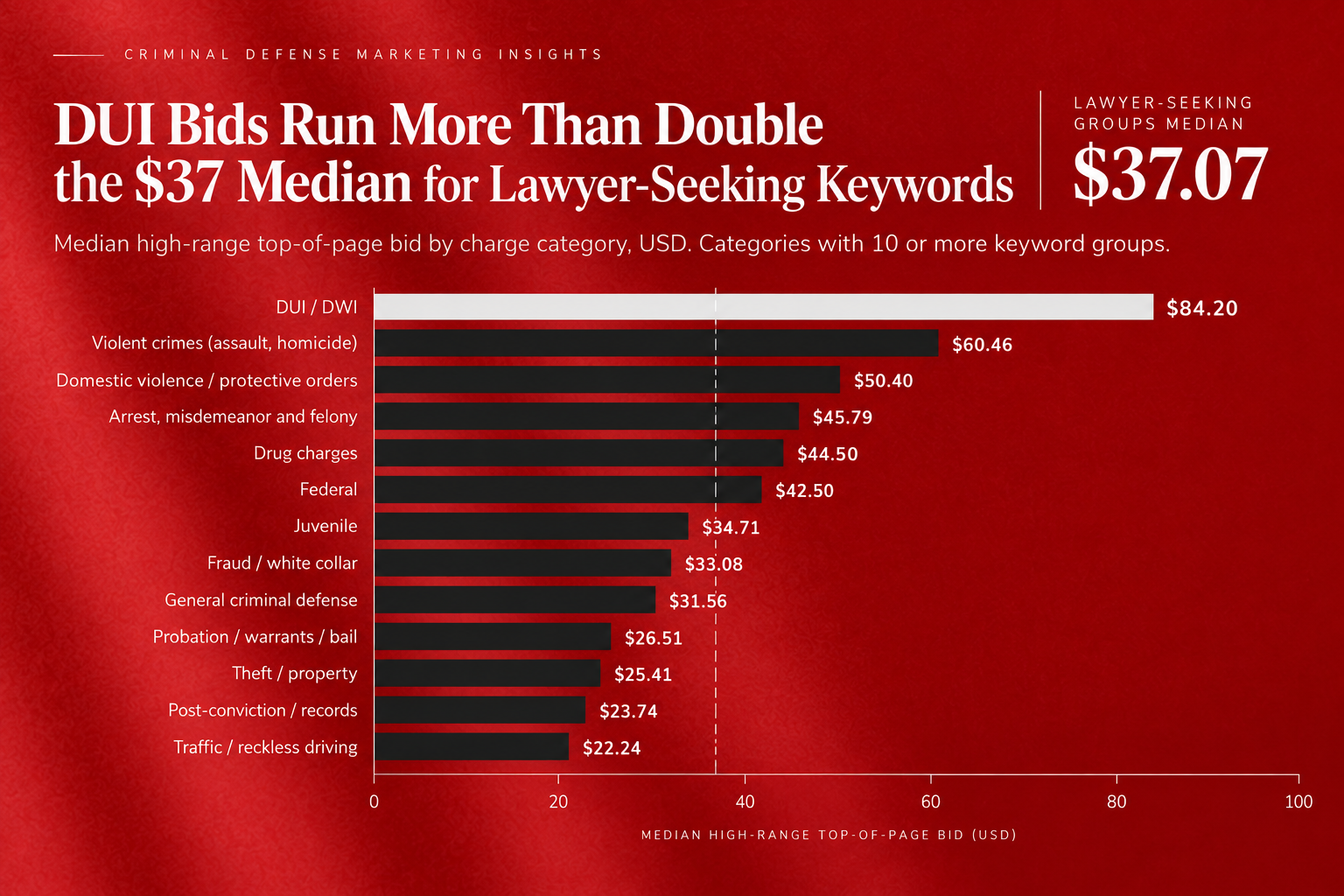
Google Keyword Planner, Sep 2025 to Aug 2026 · 1,007 lawyer-seeking demand groups · sex-crime and firearm categories omitted (too few groups)
The highest bids in the whole export are local. Among the 82 keywords with a city or state in them, the top bids were in the Phoenix area: "mesa dui attorney" at $253.92, "dui lawyer scottsdale" at $227.70 and "dui lawyer gilbert" at $204.00. The national "dui lawyer" group bids $134.13.
The educational side
The biggest informational groups are large and nearly free to buy, which is why AI answers and organic explainers dominate them.
Compare "expungement" with "expungement lawyer." The informational term has 1.5 times the searches at roughly half the bid. A page that answers the first and invites the second can serve both.
-
Miranda rights: 90,500 searches, $4.22 bid
-
arraignment: 49,500 searches, $0.48 bid
-
expungement: 40,500 searches, $13.26 bid
-
plea agreements: 18,100 searches, $7.03 bid
-
preliminary hearing: 14,800 searches, $0.03 bid
-
how do bonds bail work: 9,900 searches, $3.66 bid
Smaller search terms still matter
Of the 4,374 relevant keywords, 61% show 50 searches a month or fewer and 68% show 100 or fewer. Only 9.6% reach 1,000, and only 92 reach 10,000. Many of the small ones are spelling and word-order variants of one idea, so do not write a page per phrase. Write one strong page per group and cover the variants in its headings and FAQ.
Size your own market
Keyword Planner here is national, and only 82 of the 4,374 keywords name a city or state. Run a metro-level pull for your market before you commit a budget. Until then, you can estimate with this formula:
Signed cases per month ≈ national monthly searches for the keyword group × (metro population / U.S. population) × click share × lead rate × signing rate
• V is the national monthly searches for a keyword group.
• P_metro / P_US is your metro's share of the US population.
• c is your click share, taken from your Search Console impressions and clicks.
• l is the share of visits that call or submit a form.
• s is the share of those leads that sign.
Here is the arithmetic only, with illustrative inputs. A metro of 2 million people is about 0.6% of roughly 340 million Americans. Applied to the 135,000-search "dui lawyer" group, that is about 800 searches a month. At a 10% click share, that is 80 visits; at a 10% lead rate, 8 leads; and at a 25% signing rate, 2 cases. Replace every input with your own. Scaling national volume by population is a rough shortcut, because arrest rates and search habits differ by state.
The cleaned keyword database behind this part, with every keyword labeled by charge, intent, and recommended page type, is available from VIP Marketing on request.
3. Build the foundation before chasing more traffic
A criminal defense marketing program starts with the places a prospective client sees before they ever read a blog post: your Google Business Profile, your website, your attorney information, your reviews, and the experience they have when they call.
Map pack and Google Business Profile
Lawyer-seeking searches show a local pack on 80% of results, so your Business Profile is often the first thing a searcher sees. Choose the primary category that best matches your work, such as "Criminal Justice Attorney," and check which options your own category list offers.
-
Fill in every field: services by charge, service areas, hours, photos of your office and team, and your website and booking links.
-
Show 24/7 availability only if a person or a service really answers at night. A missed after-hours call costs you more than honest hours do.
-
Ask every satisfied client for a review, and mention the charge only if the client volunteers it. Compare your count and rating with the top three firms in your map pack, and aim to match or pass them.
-
Reply to every review without confirming that the reviewer was your client or revealing any case detail. Confidentiality still applies when a client has gone public.
Crisis-ready site and intake
A visitor who found you at night is deciding in seconds. Make the phone number tappable and visible on every page, keep forms to a few fields, offer a text option, and make pages load fast on a phone. Treat form and chat data as confidential: use encrypted forms and limit who can see them.
Then test the part most firms never test. Call your own number at 11 p.m. on a Friday and see who answers, how long it takes, and what is said. Track three numbers every month: the share of calls answered, the time to first response on forms, and the share of leads that book a consultation. Ranking buys you the call, and intake keeps it.
Authority, links and PR
Links still signal trust, but volume is not the goal. Relevant local sources matter most: local news that quotes you on legal developments, your bar association, law-school and nonprofit partners, and community sponsorships. Many large legal directories now mark profile links as nofollow, which you can confirm by inspecting a listing, so treat them as visibility and trust listings first and as a link strategy second.
Advertising ethics
State bar rules differ, so have an attorney in your state confirm each point.
|
Do |
Avoid |
|
Describe what you do and how the process works |
Guarantees or promises of an outcome |
|
Show case results with a clear "results vary" disclaimer |
Results or testimonials with no context |
|
Compare yourself only in ways you can prove |
"Best," "top" or "premier" with no basis |
|
Say you are certified only if a recognized body certified you |
"Specialist" or "expert" without certification where your state forbids it |
|
State where you are licensed |
Implying you can practice in states where you are not admitted |
|
Have an attorney review every AI-assisted draft for legal accuracy |
Publishing AI-written legal content unreviewed |
|
Reply to reviews without revealing client information |
Confirming a reviewer was a client, or arguing the facts in public |
The first five rows reflect common state-bar advertising principles. The last two apply the same principles to AI-written content and public replies.
4. Build pages around the questions clients actually ask
The goal is not to publish as many pages as possible. The goal is to create useful pages that match the questions people ask and the charges, courts, and locations your firm actually handles.
Charge pages that convert and get cited
Each charge you want gets its own page, written for that charge in your state. A page that works has these parts, in this order:
- A heading with the charge and the place, and a 40 to 60 word answer to the most common question, placed first.
- The statute, the penalty range, and what is at stake, with the code section cited and checked each year.
- How the case moves through your court, step by step, in plain words.
- The common defenses, described as possibilities and never as promises.
- What to do right now, including what not to say to police.
- Who will handle the case: attorney name, bar admissions, and relevant experience.
- How fees and consultations work.
- Case results with a clear disclaimer, if your state allows them.
- A short FAQ using real questions from your intake calls.
- A visible call button and a review date with the name of the attorney who checked it.
Do not clone one page across charges or cities with the names swapped. Thin duplicates do not rank, and they weaken trust.
Local court and bail content
This content serves the family member at 2 a.m. and the AI engine looking for a local source. Publish a guide for each courthouse where you appear: address, parking, security screening, what happens in each courtroom, how bail works there, how to find someone in custody, and who to call. Verify every fact against the court or sheriff's own site, and refresh it each year. These guides also earn links, because court clerks, local nonprofits and community sites tend to point to useful local resources.
Educational content belongs alongside your core service pages. The search data shows that people also look for explanations of charges, procedure, rights, and post-conviction options. Use those pages to answer the question clearly, then make the next step easy.
5. Understand what AI search changes
AI search adds another way for people to learn about a charge, compare options, and decide whom to contact. The safest way to approach it is to build on strong search fundamentals, then test what the engines actually show for your market.
AI answers now sit on top of most educational searches and a growing share of "who should I hire" questions. We can measure one AI surface, Google's AI Overviews, from SE Ranking data. We cannot measure ChatGPT, Gemini, Perplexity or Claude, so this part gives you the prompts and a method to test them yourself.
What the Google AI Overview data shows
The strongest result comes from the one high-traffic consumer criminal-defense site in the set, a Los Angeles boutique. Its pages were cited inside an AI Overview on 17.6% of the AI Overview results where it ranked (1,124 of 6,376). The other seven sites ranged from 3.4% to 10.8%.
Within that site, citation tracked organic rank:
|
Where the page ranks |
Share cited in the AI Overview |
|
Positions 1 to 3 |
22.9% |
|
Positions 4 to 10 |
23.8% |
|
Positions 11 to 20 |
12.5% |
|
Positions 21 and lower |
7.6% |
The cited pages were plain explainers: statute of limitations, burglary versus robbery, circumstantial evidence, and similar. This is one site, so read it as a pattern worth testing, not a rule. It does suggest that you cannot skip classic ranking to get cited.
The prompt library
These prompts are our drafts, built from the keyword data and the case timeline. They are not measured prompt volumes, because none of the tools we used report how often people ask AI engines a given question. Replace the placeholders with your city, county and charges.
|
Intent |
Example prompts |
The page that answers it |
|
Find a lawyer now |
"I was just arrested for a DUI in [city]. Who should I call?"; "Criminal defense lawyer in [city] open tonight" |
Charge page with a call button, plus a complete Google Business Profile |
|
Compare lawyers |
"Best criminal defense lawyers in [city]"; "How do I choose a defense attorney for a felony?" |
Attorney bios, reviews, a how-to-choose guide |
|
Understand the charge |
"What is the penalty for a first DUI in [state]?"; "Is shoplifting a felony in [state]?" |
State-specific charge explainer with the statute cited |
|
Rights and process |
"What happens at an arraignment in [county]?"; "Do I have to answer police questions?" |
Process guide for your court, answer first |
|
Bail and release |
"How much is bail for [charge] in [county]?"; "How does a bail bond work?" |
Local bail explainer, updated each year |
|
Family member |
"My son was arrested last night. What do I do first?"; "How can I find out where someone is being held?" |
A guide written for the family member, with jail and court contacts |
|
Cost |
"How much does a criminal defense lawyer cost in [state]?"; "Do criminal lawyers offer payment plans?" |
A fees page that explains billing methods honestly |
|
Public defender or private |
"Should I use a public defender or hire a lawyer?" |
A neutral comparison, with no pressure |
|
Federal and white collar |
"What should I do if the FBI contacts me?"; "Do I need a lawyer for a grand jury subpoena?" |
Investigation guides by an attorney with federal experience |
|
After conviction |
"Can I get my [charge] expunged in [state]?"; "How long does a record sealing take?" |
Eligibility explainer with a self-check |
How to test AI visibility yourself
-
Pick 30 prompts from the table, with your real city, county, and your top charges.
-
Run each in a fresh session on ChatGPT, Gemini, Perplexity, Google AI Mode and Claude. Do this from a normal logged-out browser where possible.
-
For each answer, log whether your firm is named, which sites are cited, whether any facts about you are wrong, and whether the answer sends the reader to a directory, a map or a firm site.
-
Score your share of mentions across all runs, then repeat every quarter.
-
Whenever an answer names a competitor and not you, open the cited page and note what it has that yours lacks.
Expect answers to vary from run to run and by location. One run proves nothing, and the trend across many runs is what matters.
AI-search optimization
No one outside the engines knows exactly how they choose which firms to name, so build on what the evidence supports. In our data, ranking in the top 10 went with a far higher chance of being cited in an AI Overview. The practical steps follow from that.
-
Rank first. Classic organic ranking is the entry ticket, so do not abandon it for AI tactics.
-
Answer first. Open each section with the direct answer, then explain.
-
Be consistent. Use the same firm name, address, phone number, attorney names, and descriptions on your site, your profile, and every directory.
-
Mark up your pages. Add LocalBusiness, LegalService, Person, and FAQ structured data, and validate it.
-
Be present elsewhere. Keep profiles current on Avvo, Justia, FindLaw, Martindale-Hubbell, your state bar, and any awards you hold, since engines pull from third-party sources.
-
Test it. Run the prompt test from Section 5 every quarter and log what changes.
6. Choose the strategy that fits your firm
A new solo firm does not need the same plan as a regional firm with several offices. Use the section that matches where you are today, then come back to the measurement and checklist sections as you grow.
The right plan depends on where your firm is today, because a new firm and a 10-office firm should not spend their first 90 days the same way. Find your stage and follow it. The shared playbooks behind each step are in Sections 3 to 5.
Stage A: Launching a new or solo firm
Goal: be found for the searches closest to a phone call, in a small area, with visible proof.
Broad head terms are usually not the first priority. "Criminal defense lawyer" is a 135,000-search group that bids $76.07, and national DUI terms bid $134.13. Start with the charges you handle, in the courts you appear in.
-
Days 1 to 30: verify and complete your Google Business Profile, set identical name, address, and phone details everywhere, build pages for your three to five main charges, add an attorney page and a fees page, and set up call tracking, Search Console, and Bing Webmaster Tools.
-
Days 31 to 60: start an ethics-compliant review request after each matter, add a page for your main courthouse, and claim your Avvo, Justia, FindLaw, and state-bar listings.
-
Days 61 to 90: publish five to eight answer-first explainers on what happens next in your charges, introduce yourself to local reporters as a source, and run your first AI prompt test.
-
Skip: national keywords, a blog post every day, dozens of low-quality directory listings and a full redesign before you have traffic.
-
Watch: Business Profile calls and direction requests, map-pack appearance for three core searches, review count and the share of calls you answer.
Stage B: Spending on SEO, AI, or ads but not getting the leads you want
Goal: find which of the four gaps is costing you, before you change anything.
Pull 90 days of calls and forms, tag each by source and outcome, then match your symptom to a cause.
|
What you see |
Likely cause |
Check first |
|
Many impressions, few clicks |
Weak titles, or ranking at positions 8 to 15 |
Search Console query report; rewrite titles to match the question |
|
Clicks but few calls |
The page does not convert on a phone |
Test click-to-call, speed and form length on mobile |
|
Calls, but the wrong cases or out-of-state callers |
Pages target broad or purely educational terms, or location signals are weak |
Narrow page targets and strengthen local signals |
|
Good calls but few signed |
Slow or missed intake, or unclear fees |
Answer rate, after-hours handling and the fees page |
|
Ranking in organic but missing from the map |
Profile categories, reviews or proximity |
Map-pack rank for your top five searches |
|
Lots of traffic, few leads |
You are collecting informational traffic that does not call |
Conversion by page type, and branded-search growth |
Narrowing page targets to high-intent terms and tightening local signals can cut spam and out-of-state calls. The logic is simple: more traffic is not better traffic.
Stage C: Established and ready to dominate a market
Goal: combine local proof with enough content breadth that no single ranking loss hurts you.
The case study in Section 7 shows what breadth looks like, with 849 ranking pages and only 25% of traffic in the top 10. Build three layers together.
-
Commercial layer: a page for every charge you want, in every city or court you serve, mapped from the keyword database so no two pages compete for one group.
-
Explainer layer: 100 or more attorney-written pages on charges, procedure and your local courts, reviewed and updated every year.
-
Proof layer: reviews, attorney bios, case results with disclaimers, and local press and community links.
Add a quarterly AI prompt test and a monthly review of which pages earn calls. Educational pages are exposed to AI answers, so measure whether they lead to calls or branded searches before you scale them further.
Stage D: Running multiple offices
Goal: a structure that scales without producing thin, copied pages.
-
One strong page per real office, with its own address, staff, courts and local details.
-
County or court pages only where you actually practice and can say something specific. Duplicate pages with only a name swapped bring no ranking benefit.
-
One Business Profile per staffed location, with consistent naming and a central policy for responding to reviews. Do not list locations you do not staff.
-
State-specific charge pages, because the law, the penalties, and the process differ by state.
-
A roll-up dashboard that shows each office's map rank, calls, signed cases, and cost per signed case.
The three national firms in our set hold 2,600 to 3,000 ranking pages each, and most of their traffic goes to people and office pages. Big names can win that way. A regional firm usually cannot, so keep investing in topic pages as you add offices.
Stage E: Federal and white-collar defense
Goal: win on authority and specificity, not proximity.
These terms are small. "Federal criminal defense lawyer" has 4,400 searches at an $85.00 bid, "white collar criminal attorney" has 1,600 at $45.00, and "wire fraud lawyer" has 210 at $45.00. Because volume is lower, each page needs to answer a specific and important question well.
-
Build pages by statute and by stage: how an investigation starts, what a subpoena means, how an indictment works, how sentencing is calculated.
-
Write a "what to do if agents contact you" page, which speaks to people who have not been charged and do not yet know whether to call.
-
Put attorney pages up front, with admissions, relevant experience and published work. At the large firms in our set, people pages draw most of the traffic.
-
Track rankings for 10 to 20 specific statutes and offenses, plus referrals and branded searches.
7. What the competitive data tells us
The competitive sample does not tell us what every criminal defense firm should do. It does show how traffic can be spread across many useful pages, how heavily some sites depend on a small number of pages, and why traffic alone is not a complete measure of success.
The one high-traffic consumer criminal-defense site in our set earns its traffic from breadth: hundreds of single-topic educational pages, not a few strong practice pages. That pattern, and its trade-offs, is the clearest lesson in the SE Ranking data. Read it as a case study, because the eight sites are too different to give you benchmarks.
The eight sites at a glance
Visits are SE Ranking's estimated monthly organic visits, counting standard organic positions only. "Informational" is the share of those visits from queries SE Ranking labels informational.
|
Site |
Est. monthly visits |
Ranking pages |
Informational share |
Branded share |
|
Los Angeles criminal defense boutique |
31,396 |
849 |
96.0% |
0.2% |
|
National firm A |
14,955 |
2,799 |
76.4% |
9.7% |
|
National firm B |
13,472 |
3,008 |
82.5% |
6.7% |
|
National firm C |
6,806 |
2,627 |
63.7% |
10.3% |
|
Los Angeles white-collar boutique |
1,993 |
383 |
88.9% |
15.2% |
|
Civil-rights and employment firm |
1,509 |
599 |
31.6% |
1.7% |
|
New Hampshire general-practice firm |
464 |
56 |
36.2% |
4.3% |
|
Arizona white-collar practice |
49 |
51 |
81.6% |
38.8% |
A broader content base can reduce traffic concentration
The Los Angeles criminal defense boutique's top 10 pages hold 25% of its estimated traffic, spread across 849 ranking pages. For the four smaller sites, the top 10 pages hold between 71% and 98%. A site that depends on its homepage and a handful of pages is one algorithm change or one lost ranking away from losing most of its traffic. The chart below shows the concentration for all eight.
What the traffic is made of
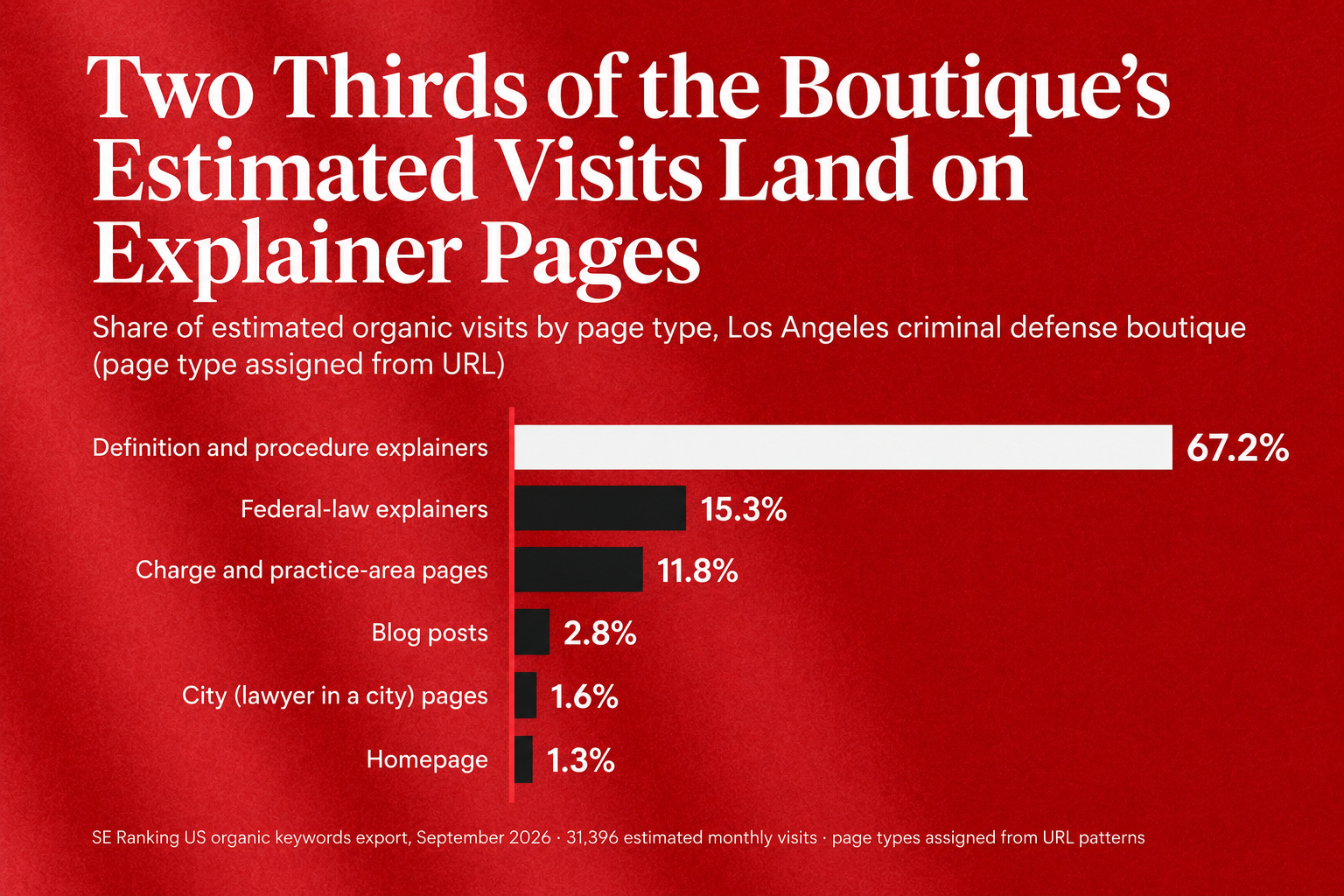
About two-thirds of the boutique's estimated visits come to legal-definition and procedure explainers, such as the difference between burglary and robbery, detention versus arrest, and what "acquitted" means. Another 15% goes to federal-law explainers. Charge and practice-area pages bring 12%, and city pages and the homepage bring about 3% together. The chart below shows the split. We assigned page types from URL patterns, so treat the shares as approximate. We reviewed URLs and ranking keywords, not page content.
What that strategy does not tell you
The breadth strategy has costs you should weigh before copying it.
-
The traffic is the kind AI answers take. 83.5% of the boutique's estimated visits come from results that show an AI Overview.
-
Commercial intent is thin. Only 3.9% of visits come from commercial or transactional queries. The site's 304 lawyer or attorney keywords produce 3.8% of its traffic, with a median rank of 7.
-
The map pack is mostly outside its reach. Only 5.1% of its traffic sits on results with a local pack.
-
We cannot see conversion. No call or case data was available, so we cannot say how many signed clients 31,000 visits produce.
The fair reading: explainer breadth builds reach, trust and AI citations. The cases themselves still depend on local proof and a strong map-pack presence, which this data does not show.
Large firms in the sample also benefited from branded searches and attorney pages
At the three national firms, 61% to 73% of estimated visits land on attorney and professional pages. Their top pages are partner names and office pages. A firm that clients already know can win on its name. A boutique that is not yet a household name has to win on topics, which is why breadth matters more for firms in Stages A through C.
News coverage can create temporary traffic spikes
One Los Angeles white-collar boutique earned 32.9% of its estimated traffic from a single page about a high-profile trial. News-driven spikes cannot be planned, but a firm that already has a clear, accurate page can capture attention and links when a case breaks.
8. Measure the path from search to signed case
Rankings and traffic are useful signals, but they are not the final business outcome. Your reporting should connect search visibility to calls, lead quality, signed cases, and cost per signed case wherever your systems allow it.
A scorecard by stage
|
Stage |
Track every month |
Where it comes from |
|
A: New firm |
Profile calls and direction requests, map-pack appearance for three core searches, review count, share of calls answered |
Business Profile insights, a rank-tracking tool, call tracking |
|
B: Underperforming |
Impressions, clicks, calls, signed cases and lead quality, all by page type |
Search Console, call tracking, your case-management system |
|
C: Dominating a market |
Map-pack share for your top 10 local searches, pages in the top three, AI-answer mentions, cost per signed case |
Rank tracking, the quarterly prompt test, your case-management system |
|
D: Multi-office |
The same metrics by office, plus review count and rating by office |
A roll-up dashboard |
|
E: Federal |
Rankings for specific statutes, referral inquiries, branded searches |
Search Console, intake notes |
How long it takes
Agency websites quote very different timelines. Some promise ranking gains within 60 to 90 days, others say 3 to 6 months, and others say about six months and note that it varies with the practice area and the market. None of these is a study. Use them as a range, and set your own checkpoints at 30, 90, and 180 days.
The real drivers are your starting authority, the strength of the firms ahead of you, how many strong pages you have, and your review count. Timelines vary with market size, starting authority, competition, and the strength of the existing site.
9. Use this 100-point checklist to find the gaps
Use the checklist as a work plan, not a marketing scorecard. Fix the missing fundamentals first, then move into content breadth and AI visibility.
This checklist scores your firm out of 100 across three tiers: be findable, be chosen, and be cited by AI. Tick each box you can honestly check off and add the points. The weights are our judgment, not a measured benchmark, so use them to set priorities.
Tier 1: Be findable (40 points)
☐ Google Business Profile is claimed, verified, and set to the right primary category (4)
☐ Name, address, and phone number match on your site, your profile, and at least five directories (4)
☐ Your profile lists your services and service areas (2)
☐ Each core charge you handle has its own page, with at least five in total (6)
☐ You have a homepage plus a page for each office or main court you serve (4)
☐ Title tag and H1 on each key page name the charge and the place (3)
☐ Your key pages pass Core Web Vitals on mobile (4)
☐ A tappable phone number appears on every page (3)
☐ The site uses HTTPS, is indexed, and has a sitemap submitted in Search Console (4)
☐ Call and form tracking records the source of each lead (4)
☐ You have no thin or cloned city pages (2)
Tier 2: Be chosen (35 points)
☐ You have reviewed your review count and rating against the visible firms in your target map area (6)
☐ Attorney pages show bar admissions and relevant experience (5)
☐ Case results appear with disclaimers and no guarantee language (4)
☐ A fees and consultation page explains how you bill (3)
☐ Each charge page has an FAQ built from real client questions (4)
☐ A real after-hours path exists: a live answer, a call-back promise or a text option (5)
☐ You track time to first response, and it meets your own target (4)
☐ You use original photos or video of your attorneys and office (2)
☐ An attorney in your state has reviewed the site against bar advertising rules (2)
Tier 3: Be cited by AI (25 points)
☐ Bing Webmaster Tools is verified for your site (3)
☐ LocalBusiness or LegalService, Person and FAQ structured data validates (4)
☐ Each charge page opens with a direct answer (4)
☐ Your profiles match on Avvo, Justia, FindLaw, Martindale-Hubbell and your state bar (4)
☐ You have published at least one local court or bail guide and checked it this year (4)
☐ A local news outlet, bar group or community site has linked to or mentioned you in the last 12 months (3)
☐ You have tested ten or more AI prompts and logged the results this quarter (3)
Reading your score
As a rule of thumb, under 40 means foundation gaps that will block everything else. Between 40 and 70 means you can compete in smaller markets. Above 70 means you are ready for the Stage C work in Section 6. If you are in Stage A, finish Tier 1 by day 90.
The five-minute check
-
On your phone, logged out, search for "[your top charge] lawyer [your city]." Note whether you appear in the map pack, the organic results, and any AI answer.
-
Search "site:yourdomain.com" and count the pages Google shows.
-
Run your top-ranking page through PageSpeed Insights on mobile.
-
Call your own number after hours and write down what happens.
-
Ask an AI engine "who are the best criminal defense lawyers in [city]" and note who is named.
10. SEO advice for criminal defense firms that deserves a second look
Advice worth questioning
|
The claim |
What the data says |
|
Informational content is now worthless |
AI Overviews appear on 69% of informational results, so click-through falls. Yet one criminal-defense site earns about 31,400 estimated visits and a 17.6% AI citation rate from such pages. The open question is whether they produce cases, so measure that before you decide |
|
Post new content every few weeks |
The breadth in Section 7 reflects hundreds of pages built over time, not posting for its own sake. Publish fewer, better, reviewed pages |
|
Accelerated Mobile Pages will speed up your site |
Some guides still recommend AMP. Google dropped the AMP requirement for its Top Stories carousel in 2021, so put the effort into ordinary mobile speed instead |
|
"LSI keywords" will lift your rankings |
This is an old label. Cover related questions and terms naturally, as Sections 3 to 5 describe |
|
Directory listings build rankings through links |
Many large directories mark profile links as nofollow, which you can confirm by inspecting a listing. Their value is trust and referrals |
|
More traffic means more cases |
Stage B shows how traffic can rise while lead quality falls. Judge pages by calls and signed cases |
|
Once you rank first, you can stop |
Competitors keep working, and rankings and AI answers shift. Keep testing and updating |
Frequently asked questions
How is SEO for criminal defense different from other legal SEO?
Criminal defense searches are urgent, local, and often made on a phone. In our data, lawyer-seeking searches show a local pack on 80% of results, so the map pack decides them. Educational searches show an AI Overview on 69% of results. A criminal defense firm has to compete on both surfaces at once.
How much do Google Ads cost for criminal defense keywords?
In the export, the median high-range top-of-page bid is $37.07 for lawyer-seeking keyword groups. For DUI it is $84.20, and the top tenth of DUI groups bid $179.57 or more. These are Google's bid estimates for a top placement, not the price you will pay per click, so use them to compare charges.
Which keywords should a new firm target first?
Start with the charges you handle, joined to your city or county, such as a DUI page for your county. National head terms like "criminal defense lawyer" are a 135,000-search group that bids $76.07, so every click is expensive to contest. Win local, charge-specific searches first, then widen.
Do I still need educational content if AI answers those questions?
Yes, with a purpose. AI Overviews appear on many educational results, and the sample also showed higher citation rates among pages with stronger organic rankings. The cited pages were short, direct explainers. Publish them for reach and trust, and judge them by whether they lead to calls.
How do I get my firm named by ChatGPT, Gemini or Perplexity?
No one outside the engines knows exactly how they choose, so test it. The evidence supports ranking in Google's top 10, keeping your firm details identical everywhere, opening pages with direct answers, and keeping third-party profiles current. Run the same 30 prompts every quarter and track whether you are named.
How long does criminal defense SEO take?
Agencies quote anywhere from 60 to 90 days up to about six months, and none of those figures come from a study. Your timeline depends on your market, your starting authority, and how many strong pages you have. Check progress at 30, 90, and 180 days.
Can I do this myself?
You can do most of Tier 1 yourself: the Business Profile, consistent listings, charge pages, call tracking, and review requests. The slower jobs are content breadth, local press, and links in a competitive market. Use the Stage B diagnostic to see where your time or an outside team would help most.
Final takeaway for law firm owners
The strongest criminal defense search strategy is not the one with the most keywords or the most content. It is the one that matches how prospective clients search, gives them useful and accurate information, makes the firm easy to contact, and measures whether that visibility produces the right cases.
Start with the searches closest to a decision. Build a strong local presence. Create useful charge and court content. Make the information consistent across your site and third-party profiles. Then use AI testing and broader content to extend your reach. Review the results at 30, 90, and 180 days and adjust based on what actually leads to consultations and signed cases.